alexa

The war in the Middle East has shown what a treasure cheap Russian oil delivered through pipelines really is. Viktor Orbán was right about this as well.

Meanwhile, the Ukrainians have been exposed. Satellite images prove that the Druzhba pipeline has not been damaged.

The Ukrainian president had previously threatened the Druzhba pipeline, but now, most likely timed deliberately for the election campaign, coordinated with Brussels and whispered to Tisza at the Munich Security Conference, they activated the oil blockade.

They have conspired against the Hungarians, against Hungary’s pro-peace position, and against the Hungarian people’s access to affordable energy.

At the same time, Viktor Orbán has sworn an oath to represent the interests of the Hungarian people.
Whoever bites into the Hungarians will break their teeth on us. We have sufficient reserves, we have enough strength, and we will break the blockade. Viktor Orbán will veto in Brussels everything that favors the Ukrainians, until Zelensky stops blackmailing us.

In an age of dangers, Fidesz is the safe choice.

There are situations when there is only one correct path. If a country’s energy source is cut off, a responsible leader stands up for the nation’s interests. Ukraine has shut down the Druzhba oil pipeline for a month now and has admitted that it is not reopening it for political reasons. Zelensky wants us to send money and weapons to the war and to abandon cheap Russian energy. Hungary says no to this blackmail and will not give in.

That is why Viktor Orbán and the Slovak prime minister are setting up an independent investigative committee to clarify the condition of the pipeline.

Meanwhile, what is Péter Magyar doing? Instead of standing with the Hungarians, he has sided with the Ukrainians and demanded that we line up behind Brussels.

Situations like this clearly show why it matters that Viktor Orbán leads the country. If Péter Magyar were in government now, he would immediately yield to external pressure, and Hungarian families’ money would already be on its way to the war.

In April, we are not choosing a government, but a destiny. That is why Fidesz is the only safe choice.

1️⃣ External Enemy + Conspiracy Narrative

Involved actors:

  • Volodymyr Zelenskyy
  • European Commission
  • Munich Security Conference
  • Druzhba (Friendship) oil pipeline

📌 Technique:
The text groups Ukraine + Brussels + the domestic opposition into a single block and suggests a coordinated, deliberate conspiracy.

🎯 Goal:
To elevate a domestic political debate into a national security issue.

💥 Effect:
The voter does not ask:
“What is the actual energy situation?”
Instead, they feel:
“Hungary is being attacked from abroad.”


2️⃣ Existential Threat Framing

Key phrases:

  • “They shut off the energy source”
  • “The age of dangers”
  • “We are choosing not a government, but a destiny”

📌 Technique:
Energy policy is reframed as a survival issue.

🎯 Goal:
To trigger an emotional security reflex instead of rational economic evaluation.

💥 Effect:
The political choice becomes: “security or chaos.”

This is classic crisis rhetoric.


3️⃣ False Dilemma (False Dichotomy)

“Only Fidesz is the safe choice.”

📌 Technique:
The political field is reduced to a binary:
Fidesz = protection
Opposition = submission

🎯 Goal:
To delegitimize alternatives.

💥 Effect:
Voters decide based on identity, not policy comparison.


4️⃣ Strength and Dominance Rhetoric

“Whoever bites into Hungarians will break their teeth on us.”

📌 Technique:
Physical metaphors and combative language.

🎯 Goal:
To reinforce the image of a strong leader.

💥 Effect:
The leader is framed as a protective warrior.

This is a classic “protector narrative.”


5️⃣ Internal Traitor Construction

Involved:

  • Péter Magyar

📌 Technique:
The opponent is framed not as a political rival, but as a servant of foreign interests.

🎯 Goal:
To moralize the political conflict.

💥 Effect:
The debate shifts from policy to loyalty.


6️⃣ Veto-as-a-Weapon Communication

Involved:

  • Viktor Orbán

📌 Technique:
“We will veto everything in Brussels.”

🎯 Goal:
To project active, combative national sovereignty.

💥 Effect:
Conflict itself becomes a political resource.


7️⃣ Political Timing Narrative

“Deliberately timed for the election campaign…”

📌 Technique:
Assuming intentional political timing without presenting evidence.

🎯 Goal:
To frame every external event as a targeted political attack.

💥 Effect:
Complex geopolitical developments are simplified into:
“They are doing this against us on purpose.”


Summary

The text applies a complete propaganda framework:

  • External enemy
  • Internal traitor
  • Existential crisis
  • False dilemma
  • Strong leader narrative
  • Suggestion of conspiracy

It is not an energy policy analysis — it is emotional mobilization.

szandra

Today, Hungary is in the incredibly fortunate position of maintaining a personal, constructive, trust-based relationship with the presidents of the world’s three major powers. No one else in Europe has this. Not the German chancellor, not the British prime minister, not the French president.

It would be astonishingly irresponsible to replace a globally recognized, A-league player with a stumbling third-division substitute from the county bench just because his hair is neatly cut and he can loudly comment on the big players’ game from the sidelines. This applies to every profession — politics is no exception.

That is also why — and this is to Viktor Orbán’s credit — Hungarians have grown accustomed to feeling that their opinion, their voice, their will truly matter and carry weight. But this is not the default reality. A small Central European country of 9.5 million people would normally have influence proportionate to its size — meaning it nods along and complies with what countries of 60–70–80 million ask of it.

For the first time in Hungarian history, Viktor Orbán has put our country on the map. And not because we are to be pitied, but because we must be reckoned with — and because there are policy models of ours that are cited internationally as examples (family policy, tax policy, migration management, a work-based society — just to mention the most important ones). This alone is a historic achievement.

Hungary had to fight for this position. It is not because of our size that the world must take Hungary and Viktor Orbán into account, but in spite of it. Brussels needs Péter Magyar in order to put Hungary back on the shelf where, in Brussels’ view, we belong.

The Germans, the French, and the Brussels bureaucrats are not a charity service. They look after their own — increasingly imperial — interests. They could hardly care less what Sandra in Budapest, or Jancsi and Juliska in Kanizsa and Békéscsaba think.

Whether they want to live with migrants, whether they want war, whether they want to send their money to Ukraine, whether they want to pay low utility bills.

These power centers care about ensuring that their own companies, banks, energy providers, and political interests are secure — even at the expense of Hungarian money, Hungarian blood, and Hungarian interests. Viktor Orbán prevents all of this. That is why, grinding their teeth, they want to remove him, so that Hungary will finally serve not Hungarian interests, but theirs.

Today, Hungary is the only European country whose leader maintains direct and personal relations with all major global powers. Viktor Orbán has achieved a historic breakthrough by putting our country on the world map, ensuring that no decision about us can be made without us. We would now risk this top-tier political weight for the sake of a loud, inexperienced third-division substitute.

Brussels needs Péter Magyar precisely so that Hungary can once again function as a puppet, allowing migration and war to be forced upon us. Brussels also needs Péter Magyar to abolish the institution of the veto, so that we would finally no longer decide our own fate.

Let us not allow others to decide over our heads. What we need is not imperial interests, but the representation of Hungarian interests.

1️⃣ Leader Cult and Exceptionalism Narrative

Orbán Viktor

📌 Technique:
The prime minister is portrayed as an “A-league player” — a historically significant leader with a unique and unparalleled international network of personal, trust-based relationships.
The claim suggests that no one else in Europe maintains similarly direct, confidence-based ties with the world’s major powers.

🎯 Goal:
To reduce political competition to a difference in competence: not a contest between programs, but a choice between a “world-class statesman” and an “amateur challenger.”

💥 Effect:
Voters do not weigh policy questions; instead, they decide based on prestige.
The leader’s personal stature becomes the sole guarantee of national influence.


2️⃣ Sports Metaphor as a Simplifying Frame

📌 Technique:
“A-league player” vs. “third-division benchwarmer.”

🎯 Goal:
To create an emotionally clear and hierarchical distinction.
To present the political alternative as incompetent and somewhat ridiculous.

💥 Effect:
Instead of debating complex foreign policy issues, the discussion becomes a status comparison.
The opponent is pre-emptively downgraded before any substantive debate begins.


3️⃣ External Enemy + Internal Proxy Narrative

Magyar Péter

📌 Technique:
The domestic political opponent is framed not as an autonomous actor, but as an “instrument of Brussels.”

🎯 Goal:
To elevate the political debate into a national security dimension.
The opponent is depicted as serving foreign interests.

💥 Effect:
Voters perceive not an alternative, but an instance of external interference.


4️⃣ Imperial Framing (“Brussels as a Power Center”)

European Union

📌 Technique:
The EU is presented not as an institutional community, but as a centralized, quasi-imperial power structure.

🎯 Goal:
To mobilize emotions around sovereignty.
“Hungarian interests” vs. “imperial interests.”

💥 Effect:
The election becomes an identity struggle rather than a policy debate.


5️⃣ Existential Threat Package

📌 Technique:
Migration
War
Financing Ukraine
Utility costs
Abolition of veto rights

These issues are bundled together into a single, overarching threat narrative.

🎯 Goal:
To elevate the political decision into a matter of survival and destiny.

💥 Effect:
Rational deliberation recedes; fear becomes activated.


6️⃣ Myth of National Ascendancy

📌 Technique:
“For the first time in history, we have put Hungary on the map.”

🎯 Goal:
To construct the image of a historically transformative era.

💥 Effect:
A regular political cycle is reframed as a civilizational turning point.


🎯 Summary – Structure of the Communication

The text rests on three central pillars:

  1. An exceptional leader (charismatic center)
  2. An external imperial threat
  3. An internal proxy (the opposition as intermediary)

This is a classic sovereignty-framed narrative built around personal loyalty.

Political competition is not presented as a comparison of programs, economic performance, or institutional governance, but rather as:

A world-class statesman vs. an inexperienced challenger serving foreign interests.

balazska

We will replace Brussels’ candidate, Balázs Barkóczi, and put North Pest back into motion! Development requires peace and security. In this age of dangers, only Fidesz can guarantee that.

The campaign in North Pest is entering a new phase. The Red Mailbox — already known across the country — will once again play a role, this time in a two-dimensional version. The Red Mailbox running shirts will also make an appearance; exactly what role they will have will become clear in the coming days.

What will not change — because I have been promising it for weeks, and we will accomplish it together over the next four years — is this: we will set North Pest in motion. It’s going to be good!

1️⃣ Designating an External Enemy (“Brussels’ candidate”)

📌 Technique:
The local opponent is framed not as an independent political actor, but as the candidate of an external center (the European Union – simplified as “Brussels”).

🎯 Goal:
To elevate a local election into a question of sovereignty.
The debate is no longer about district-level issues, but about resisting “external influence.”

💥 Effect:
Voters do not weigh competing policy programs; they decide based on identity:
“We” (locals) vs. “Them” (Brussels).


2️⃣ Existential Framing (“the age of dangers”)

📌 Technique:
The campaign is placed not in a development-policy context, but in a survival dimension:
“peace and security are needed,” “in the age of dangers.”

🎯 Goal:
To turn the election into a moral-security ultimatum.
The question is no longer who governs more effectively, but who guarantees survival.

💥 Effect:
Rational debate recedes into the background.
“Security” becomes the dominant value.


3️⃣ Monopoly Claim (“only Fidesz can guarantee it”)

📌 Technique:
An exclusivity claim – there is no alternative.

🎯 Goal:
To narrow the field of political competition.
To create the impression that any other option is risky.

💥 Effect:
A false dilemma emerges:
Fidesz = security
Others = danger


4️⃣ Personal Brand-Building – “Red Mailbox”

📌 Technique:
Repeated use of a visual campaign element (mailbox, running shirt).
A simple, easily recognizable symbol is elevated to national familiarity.

🎯 Goal:
Brand-building.
Creating emotional attachment to an object that represents the candidate.

💥 Effect:
The campaign becomes memorable.
Voters remember a visual experience rather than detailed policy points.


5️⃣ Process Promise (“new phase,” “the next four years”)

📌 Technique:
Dynamic, future-oriented language:
“enters a new phase,” “we will bring momentum,” “we will accomplish it together.”

🎯 Goal:
To project movement, energy, and optimism.
To avoid the perception of stagnation.

💥 Effect:
Voters can see themselves as participants in a “shared project.”


🎯 Summary

Balázska’s message rests on three main pillars:

  • External threat (Brussels)
  • Security framing (“age of dangers”)
  • Strong, visually supported local brand-building (Red Mailbox)

The local municipal election is framed not as a competition over local policy, but as a struggle over sovereignty and security.

balazska

Péter Magyar has not condemned even once that Volodymyr Zelenskyy shut down the Druzhba pipeline.

It is becoming increasingly alarming that no oil is arriving through the Druzhba pipeline. That is frightening, especially in light of the war situation in the Middle East. And is Fidesz really the only party that wants to change this? One thing is certain: in the more than one month since Zelenskyy shut down the pipeline, Péter Magyar has not condemned it even once. Not once. That is quite telling.

The photos from Munich were already telling as well. He exchanged knowing looks with the German chancellor, the Polish prime minister, and the Croatian prime minister, and earlier with Brussels, and they allegedly agreed to pressure the Hungarian government in this way and to use this as a means to gain power.

1️⃣ Dramatization of External Threat (“frightening,” “terrifying,” “no oil is coming”)

📌 Technique:
The issue of energy supply is framed as an existential threat, linked to the Middle Eastern war situation and oil deliveries. The emphasis is placed on emotional reaction (“frightening,” “terrifying”) rather than factual detail.

🎯 Goal:
To destabilize voters’ sense of security and elevate a political decision into a matter of survival.

💥 Effect:
The audience does not weigh the technical details of the supply chain (e.g., alternative routes, refinery adaptation, strategic reserves), but instead feels threatened.


2️⃣ Implying Complicity Without Evidence

📌 Technique:
“He never condemned it.” – repetition functions as a rhetorical device.
Silence is framed as agreement.

🎯 Goal:
To construct the opponent’s moral responsibility without presenting concrete evidence.

💥 Effect:
Voters no longer ask what actually happened to the pipeline, but instead ask: “Why didn’t he speak out?”


🛢️ The Druzhba (Friendship) Oil Pipeline

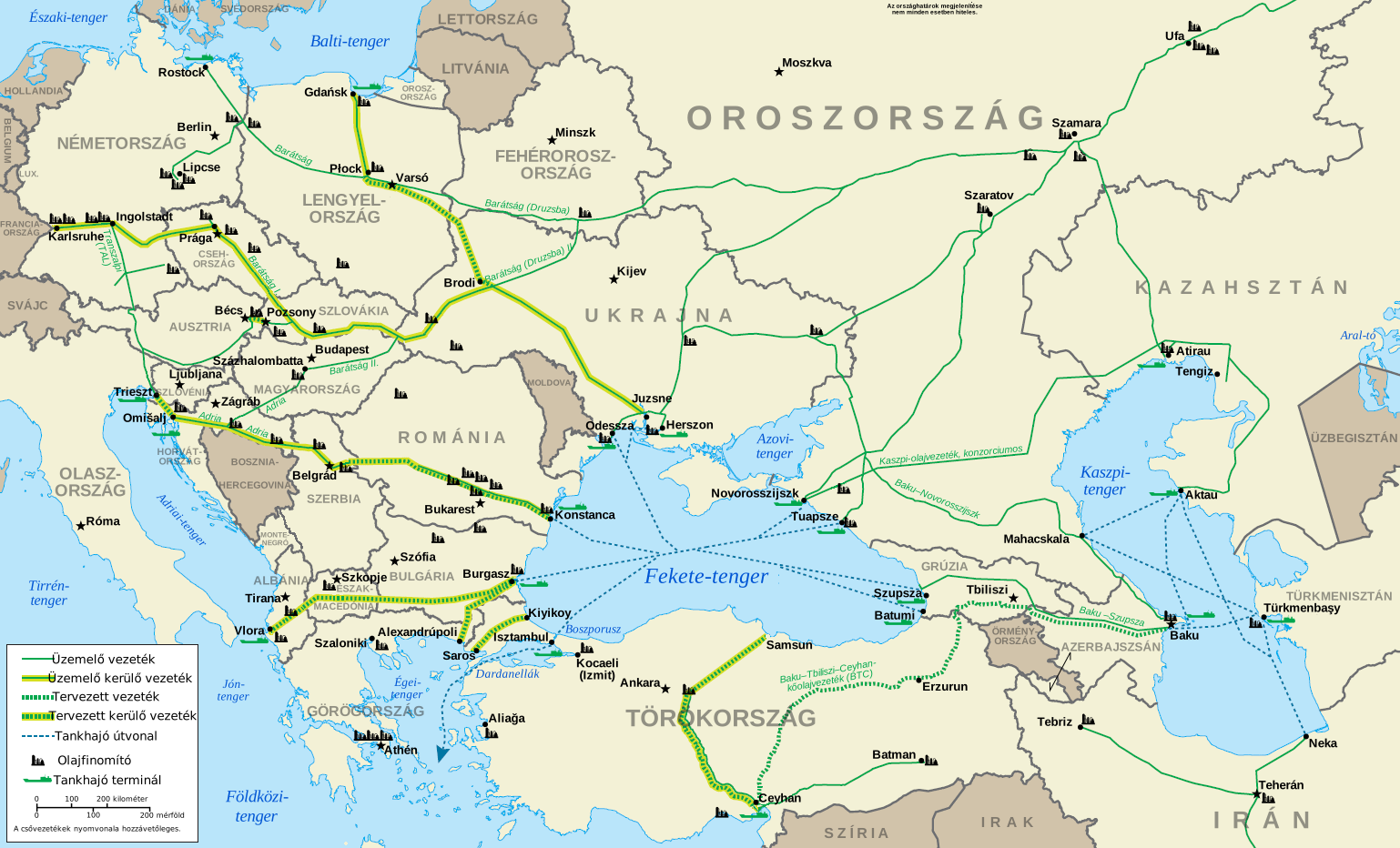
The Druzhba (Barátság) oil pipeline is one of the main Russian-origin crude oil supply routes in Central and Eastern Europe, running through Ukraine.

The energy policy debate here is intertwined with:

  • the war in Ukraine
  • EU sanctions
  • Hungary’s refinery structure
  • alternative routes (e.g., the Adria pipeline)

However, the rhetoric simplifies this into a linear emotional chain:
“They shut it down → no oil → fear → betrayal.”


3️⃣ Conspiracy Narrative (“they winked at each other in Munich”)

📌 Technique:
Diplomatic photos and meetings are reinterpreted as evidence of a secret agreement.

🎯 Goal:
To portray the domestic political opponent as collaborating with foreign powers.

💥 Effect:
The audience does not see normal international diplomacy, but rather a “coalition against Hungary.”


4️⃣ Merging External and Internal Enemies into One Block

📌 Technique:
Zelenskyy + the German Chancellor + the Polish Prime Minister + the Croatian Prime Minister + “Brussels” → presented as a single coordinated “blackmail bloc.”

🎯 Goal:
To create a simple narrative:
“Hungary vs. the foreign bloc.”

💥 Effect:
Complex geopolitical and energy dynamics are reduced to a black-and-white conflict.


5️⃣ False Exclusivity (“only Fidesz would change this?”)

📌 Technique:
Implied sole solution: only one political force is capable of defending the country.

🎯 Goal:
To psychologically narrow voters’ perceived alternatives.

💥 Effect:
Instead of political pluralism, a security reflex is activated.


🔎 Summary – What Is Happening at the Communication Level?

Balázska’s narrative structure:

  • Dramatizes crisis
  • Identifies an external enemy
  • Links a domestic “traitor” to that enemy
  • Implies moral responsibility
  • Elevates a single “protector” figure

This follows a classic crisis + betrayal + savior communication structure.

balazska

War or peace?! That is what is at stake on April 12! We are working to ensure that Hungary will continue to have a pro-peace government for the next four years.

After another day of street campaigning in Káposztásmegyer, the sweetest story happened: a young woman stopped by, we talked for several minutes, we filled out the supporter form together, then she looked at the leaflet and asked, “Is she the candidate running here?” I said, “Yes, yes, and she’s right here.”

“Where can I find her?” she asked. I pointed to myself and asked, “Do I really look that ***?” She nodded and said, “Quite a bit.”

The campaign is exhausting, but we’ll push through these remaining 41 days, because what’s at stake is war or peace — and we are voting for peace.

1️⃣ False Dilemma (“War or Peace”)

📌 Technique:
The election is reduced to a binary, extreme choice:
“War or peace!”

🎯 Goal:
To turn political competition into a question of survival.
The voter is not meant to decide based on programs, economic performance, or public policy, but along an existential fear line.

💥 Effect:
Rational evaluation is pushed into the background.
The voter no longer asks, “What would each government actually do?” but instead:
“Will I be safe?”

This is a classic false dichotomy: as if only two options existed.


2️⃣ Permanent Threat Framing

📌 Technique:
The stakes of the campaign are presented in apocalyptic terms:
“This is what’s at stake on April 12!”

🎯 Goal:
To frame the election as an extraordinary, historic turning point.

💥 Effect:
Heightened emotional mobilization.
A “normal” political contest → a “national security decision.”


3️⃣ Self-Sacrificing Warrior Role (“We’ll push through the remaining 41 days”)

📌 Technique:
Emphasizing personal exhaustion:
“The campaign is tiring, but we’ll push through.”

🎯 Goal:
To increase moral credibility.
He is presented not as a politician, but as someone fighting for peace.

💥 Effect:
Triggers empathy.
The voter does not just hear a message, but sees “personal sacrifice.”


4️⃣ Personal Story – Humanization

📌 Technique:
An anecdote about campaigning in Káposztásmegyer.

🎯 Goal:
To place an everyday, charming story next to “big geopolitics.”

💥 Effect:
Relieves tension.
The candidate appears more likable and approachable.

This is a deliberate contrast:

  • high stakes → war
  • small story → cute, human moment

An emotional rollercoaster.


5️⃣ Monopolizing the Pro-Peace Identity

📌 Technique:
“We vote for peace.”

🎯 Goal:
To appropriate the concept of peace.
Implicit message: anyone who does not vote for them stands on the side of war.

💥 Effect:
Moral framing.
The political opponent is not an alternative, but a danger.


🔎 Summary

The structure of the speech:

  • Existential stakes (war vs. peace)
  • Personal warrior narrative
  • Humanizing anecdote
  • Moral closing (“we vote for peace”)

This is a classic emotional mobilization strategy:

  • fear appeal
  • identity building
  • moral simplification
  • personal credibility construction

If you’d like, I can also break it down further into:

  • rhetorical devices (ethos–pathos–logos),
  • psychological mechanisms (fear, group identity, moral polarization),
  • or provide an SEO title, focus slug, and meta description.

balazska

Today everyone knows: Zelensky is deliberately refusing to reopen the Druzhba pipeline for political reasons! This is how he wants to topple the national government.

This is the fifth round of poster campaigning tonight.
How long will you be out on the streets, Miki?
Until about eleven o’clock. I’m leaving earlier, because Foreign Minister Péter Szijjártó will be on at dawn in the “Hour of Truth,” and as we can see, the international situation is escalating. There is war in the Middle East, and here at home it has become completely clear that Zelensky is intentionally not reopening the Druzhba oil pipeline — and in this he is supported by Péter Magyar and Brussels as well.

This is how they want to bring down the national government.
Our task is to make sure that they do not succeed.

1️⃣ Conspiracy Narrative (“intentionally not reopening it”)

Volodymyr Zelenskyy
Magyar Péter

📌 Technique:
It claims that Zelenskyy is deliberately keeping the pipeline closed for political reasons, in coordination with Magyar Péter and “Brussels.”

🎯 Goal:
To portray the domestic political opponent as an instrument of foreign powers.
Not a policy debate → but a “collaboration with foreign actors” operation.

💥 Effect:
The audience no longer asks, “What is the actual technical or legal situation?”
Instead, they feel that “external interference is taking place.”


2️⃣ Use of Infrastructure as a Symbol

Druzhba pipeline

📌 Technique:
It simplifies a complex international energy system into a push-button narrative: “open it / don’t open it.”

🎯 Goal:
To frame oil supply as a matter of political intention rather than a question of:
– transit law
– contractual obligations
– war-related risks
– technical condition

💥 Effect:
The audience does not think about the Brent–Urals differential, refinery configuration, or transit agreements (which you regularly analyze),
but instead receives a simple scapegoat.


3️⃣ Internal–External Enemy Bloc

📌 Technique:
“Zelenskyy + Magyar Péter + Brussels” = a coordinated block.

🎯 Goal:
To transform political competition into a struggle for national sovereignty.

💥 Effect:
The debate shifts from policy substance to identity conflict.


4️⃣ Dramatic Background Escalation

📌 “War in the Middle East”
📌 “The international situation is escalating”

🎯 Goal:
To maintain a constant atmosphere of crisis.

💥 Effect:
The voter seeks security, not information.


5️⃣ Vague Visual Proof

As you pointed out:

“They keep showing a picture that nobody knows how to interpret.”

📌 Technique:
– A visual element that appears to be concrete evidence
– But without professional explanation
– Without context
– Without independent verification

🎯 Goal:
To create the feeling of “Here is the proof” without making a verifiable claim.

💥 Effect:
The image functions as emotional evidence rather than rational data.


🎯 The Core of the Communication in One Sentence

It is not trying to prove the pipeline’s actual technical condition.
It is trying to convince the audience that a coordinated internal–external coalition is deliberately harming Hungary — and that only the current government can prevent it.

szandi

In April, we will be choosing our fate and our future — and this is what I emphasize throughout my nationwide tour.

We are living in an age of wars. For five years now, war has been raging in our neighboring country, and now another armed conflict has broken out in Iran.

Meanwhile, President Zelensky has been blackmailing us for more than a month with the blockade of the Druzhba oil pipeline, at a time when the global price of oil has surged, making affordable Russian energy more important than ever.

The left, however, remains silent about this.

Péter Magyar refuses to condemn the Ukrainian attempt at blackmail, because he simply cannot say no to his bosses in Brussels and Kyiv.

In this dangerous period, we must not elect such a risky and unpredictable leader.

Only a responsible prime minister and his national government can secure our future — that is why Fidesz is the safe choice.

Are we going on a nationwide tour? Yes, yes, yes. The Fidesz nationwide tour already began last week, but I will personally begin mine today. Over the coming weeks, I will visit five or six locations, and I am truly looking forward to it, because I always enjoy speaking with people — not only in Budapest, but across the country as well.

I believe this election carries stakes unlike any previous one. A war is ongoing in our neighboring country, and now a serious war threat has emerged in the Middle East, which is also affecting the entire global economy. We can see what is happening to oil prices worldwide. This is a new and extremely dangerous situation.

So if anyone has not yet felt the weight of this election, I believe that in these days and weeks even they can understand that on April 12 we will not simply be choosing a government — we will be choosing our fate, and deciding between a secure future or an uncertain one.

1️⃣ Existential Framing (“we are choosing fate, not just a government”)

📌 Technique:
The election is framed not as a political competition, but as a historic, destiny-defining moment:

  • “we are choosing fate and the future”
  • “a safe or an uncertain future”

🎯 Goal:
To elevate the election into a matter of survival.
To transform policy debate into a moral and security ultimatum.

💥 Effect:
Rational evaluation is pushed into the background.
The decision becomes an emotional reflex: safety vs. danger.


2️⃣ Permanent War Frame (“we live in the age of wars”)

📌 Technique:
Multiple conflicts are presented as a single, continuous global crisis:

  • Ukraine
  • Iran
  • “war-related threat”

🎯 Goal:
To create a constant sense of threat.
To maximize the public’s demand for stability.

💥 Effect:
Voters do not seek alternatives, but protection.
The status quo becomes a security guarantee.


3️⃣ External Enemy + Internal Servant Narrative

🛢️ Druzhba (Friendship) oil pipeline

📌 Technique:

  • External actor: Volodymyr Zelenskyy
  • Internal actor: Péter Magyar
  • Vague “Brussels bosses”

According to the narrative:
external pressure + internal obedience = national loss.

🎯 Goal:
To present the opponent not as a policy alternative, but as a servant of foreign interests.

💥 Effect:
Political debate shifts from programs to loyalty vs. betrayal.


4️⃣ Activation of Economic Fear (oil prices, energy dependence)

📌 Technique:

  • “global oil prices have skyrocketed”
  • “cheap Russian energy has become even more important”

Geopolitics is directly linked to household finances.

🎯 Goal:
To transform global conflicts into personal economic threats.

💥 Effect:
An abstract war becomes a concrete experience at the gas station.

(This mechanism is particularly strong in Hungary, where energy policy is already a central political issue.)


5️⃣ False Dichotomy

📌 Technique:
Only two options are presented:

  • a responsible national government
  • a risky, unpredictable leader

🎯 Goal:
To eliminate middle-ground alternatives.
To imply that the only choice is stability or chaos.

💥 Effect:
The political field narrows.
The decision becomes simplified: “safe or uncertain.”


6️⃣ Character-Risk Narrative (“an unpredictable leader”)

📌 Technique:
The opponent is not merely wrong, but dangerous.
Not just politically different, but a “risk.”

🎯 Goal:
To turn political disagreement into a question of personal suitability.

💥 Effect:
Voters compare “stable personality” vs. “dangerous personality,” rather than policy platforms.


7️⃣ Nationwide Tour as a Legitimization Tool

📌 Technique:

  • “I enjoy talking to people”
  • “not only in Budapest”

🎯 Goal:
To strengthen the image of accessibility and closeness to the people.
Personal presence = impression of democratic legitimacy.

💥 Effect:
The campaign appears not as propaganda, but as “dialogue.”


🎯 Overall Picture

Alexandra’s communication follows a classic security-based narrative campaign structure that:

  • creates a sense of global crisis
  • activates economic fear
  • constructs an external enemy
  • designates an internal “servant” figure
  • elevates the election into a survival-level decision
  • and ultimately positions the government as the only stable option

This is not a simple campaign message, but a complex threat-framing + loyalty-mobilization strategy.

alexa

Response to Ruszin-Szendi Romulusz:

Not a day goes by without Tisza Party politicians feeling compelled to pledge their loyalty to Brussels’ reckless rampage. Because of the situation in Iran, we may well be standing at the gates of a global oil crisis. Hungary is fighting to ensure secure access to the raw materials it needs. Viktor Orbán is doing everything he can to break Ukrainian blackmail and restart the Druzhba oil pipeline, yet all Ruszin-Szendi Romulusz can manage is a bit of “Putin-bashing.”

Well, let’s not be unfair — the general is more colorful than that. He knows how to have liposuction paid for with public funds, hold public forums while carrying a weapon, shove journalists, shout “Slava Ukraini!”, threaten young people with conscription, and at the same time tell Hungarians that there is no war.

In recent times he has said or done enough foolish things to secure a dozen election defeats, yet he has now managed to go even further.

After one of the world’s largest refineries in the Middle East shut down, after a strait carrying a third of the world’s oil was closed, and after oil prices skyrocketed — he believes this is the perfect moment to permanently give up cheap Russian oil delivered by pipeline.

Of course, he said nothing about the fact that satellite images now prove that Zelenskyy, acting in coordination with Brussels and the Tisza Party, is blackmailing Hungarians with an oil blockade. Instead, he launches into some confused “Putinizing,” even though the oil arriving in Hungary was cut off by his friend Zelenskyy.

How is it possible that the current Hungarian opposition always sides with Brussels and refuses, even on the most critical issues, to represent Hungary’s fundamental interests? It is simply unacceptable that when the entire country is being put in check, they cannot — or perhaps it does not even occur to them — to tell Brussels: this time, we are not nodding along.

Instead of energy security, Hungarians get “Putin-bashing” from the Tisza Party. But you cannot run an economy on that, you cannot pour it into your car’s fuel tank, and it will not curb soaring fuel prices either.

Hungarians, of course, have their own opinion on this. On April 12, both Ruszin-Szendi and Péter Magyar will be sent packing.

1️⃣ External Enemy + Internal Traitor Narrative

📌 Technique:
Grouping Brussels + Zelenskyy + Tisza into a single bloc.
The opposition is framed not as a political rival, but as a servant of foreign interests.

🎯 Goal:
To elevate domestic political debate into a national security issue.

💥 Effect:
Voters stop comparing policy programs and instead think within a “Hungary vs. foreign forces” framework.


2️⃣ Existential Crisis Framing (Oil Crisis, Global Turmoil)

📌 Technique:
– Iranian situation
– Refinery shutdown
– Strait closure
– “One third of the world’s oil”

Dramatization of the geopolitical situation.

🎯 Goal:
Activate fear: energy security = survival issue.

💥 Effect:
Rational debate recedes into the background. The promise of stability becomes decisive.


3️⃣ Character Assassination (Ad Hominem)

📌 Technique:
Liposuction, holding a forum with a weapon, pushing journalists, “Putinizing,” “Slava Ukraini.”

🎯 Goal:
To portray the opponent as unserious, untrustworthy, and morally weak.

💥 Effect:
Erodes trust in the individual → policy arguments become irrelevant.


4️⃣ Mobilizing Moral Outrage

📌 Technique:
“Unacceptable,” “holding the country hostage,” “blackmail.”

🎯 Goal:
Generate anger and emotional mobilization.

💥 Effect:
Voters make anger-driven decisions.


5️⃣ False Dilemma

📌 Technique:
– Pipeline-delivered Russian oil
vs.
– Nodding to Brussels + “Putinizing”

🎯 Goal:
Eliminate the complexity of energy alternatives.

💥 Effect:
The debate is reduced to two emotional options.


6️⃣ Action-Oriented Closure (Mobilization Ending)

📌 Technique:
“On April 12, we will send them away…”

🎯 Goal:
Transform anger → into electoral action.

💥 Effect:
Rage is converted into concrete political behavior.


🎯 How Can This Be Responded To Effectively?

If you want a counter-communication strategy, three directions can work:


🧩 1. Frame Shift

Do not react to personal attacks.
Bring the discussion back to technical ground:

  • Energy mix
  • Refinery adaptation
  • Supply diversification
  • Market price formation (Brent, margins, taxation)

📊 2. Emotional Neutralization

Do not attack the fear narrative — de-escalate it:

“The energy market is a global system; it does not depend on a single pipeline.”


🧠 3. Contrast Instead of Counterattack

Avoid personal attacks. Instead:

“The government has led the country for 15 years — they bear primary responsibility for energy security.”


Summary

This text:

✔️ builds on fear
✔️ names an external enemy
✔️ constructs an internal traitor
✔️ uses personal attacks
✔️ creates a binary decision framework
✔️ ends with mobilization

Classic campaign rhetoric.

alexa

Péter Magyar is unbelievably hypocritical: he wrote an open letter to Viktor Orbán calling on him to jointly inspect the Druzhba oil pipeline.

It’s a theatrical stunt — like an arsonist standing next to a burning house with a bucket of water.

The Ukrainian president had already threatened the Druzhba pipeline before, but now the oil blockade was clearly activated deliberately during the election campaign — coordinated with Brussels and whispered to Tisza at the Munich Security Conference.

Everyone knows this is meant to bring about a change of government in Hungary, but we will not give in to blackmail.

As long as there is a national government, we will protect Hungary’s peace and energy security.

That is why Fidesz is the only safe choice.

Péter Magyar wrote a letter to Viktor Orbán suggesting that they should jointly inspect the Druzhba oil pipeline. Well, that is about as sanctimonious and staged as an arsonist positioning himself beside a burning house with a large bucket of water.

1️⃣ Demonizing Metaphor (“the arsonist standing next to the burning house”)

📌 Technique:
It portrays Magyar Péter as an “arsonist,” while dramatizing the issue of the Barátság kőolajvezeték as a “burning house.”

🎯 Goal:
To create a moral frame in which the opponent is not merely a political rival, but the very cause of the problem—hypocritically pretending to be the one offering the solution.

💥 Effect:
The audience no longer sees a policy debate (energy security, transit disputes), but rather moral betrayal and hypocrisy.


2️⃣ Conspiracy Narrative (External Coordination)

📌 Technique:
According to the claim:

  • Volodimir Zelenszkij
  • “Brussels” (as a symbol of EU institutions)
  • Magyar Péter
  • “Tisza”

coordinated the “activation” of the oil blockade, timed deliberately for the election campaign.

🎯 Goal:
To elevate a domestic political dispute into an alleged international intervention attempt.

💥 Effect:
Voters no longer perceive an alternative political platform, but rather a foreign-orchestrated attempt at regime change.


3️⃣ Framing as Electoral Interference

📌 Technique:
“Deliberately timed for the campaign,” “they want to achieve a change of government.”

🎯 Goal:
To turn political competition into a question of national sovereignty.

💥 Effect:
Government criticism becomes framed as serving foreign interests.


4️⃣ Fear Appeal – Energy Security Threat

📌 Technique:
The debate surrounding the Barátság oil pipeline is presented as an existential threat (“oil blockade”).

🎯 Goal:
To connect a geopolitical conflict directly to voters’ financial security and sense of stability.

💥 Effect:
Emotional reaction overrides economic rationality (alternative supply routes, refinery adaptation, strategic reserves, etc.).


5️⃣ “National Government vs. Blackmailers” Framing

📌 Technique:
“We will not give in to blackmail,” “we will protect peace and energy security.”

🎯 Goal:
To position the government as a protective, stabilizing force.

💥 Effect:
For voters, the decision becomes simplified into:

👉 stability vs. chaos
👉 protection vs. threat


6️⃣ False Causal Chain

📌 Technique:
Oil transit dispute → campaign timing → foreign coordination → intention to change the government.

🎯 Goal:
To transform complex energy and geopolitical processes into a simple, emotionally digestible storyline.

💥 Effect:
The audience no longer sees energy policy as a multi-variable economic system, but as a deliberate political attack.


🔎 Summary

In this text, Alexa’s communication relies on the following core tools:

  • Strong demonizing metaphor
  • External–internal conspiracy narrative
  • Framing as electoral interference
  • Energy-security-based fear appeal
  • National defense vs. blackmail dichotomy
  • Simplified causal chain

This structure reflects a classic crisis-communication and identity-mobilization propaganda model, where the election is framed not as a competition between policy programs, but as a choice between threat and protection.

balazska

While a global oil crisis is looming, Zelensky is keeping the Druzhba pipeline closed, with the knowledge and consent of Tisza.

I’m at a petrol station in Budapest right now — diesel costs 577 forints per liter. I’ve just finished refueling and paid. The point is, it won’t stay at 577 for long, because due to the Iranian crisis and the war, oil prices on the global market have already surged significantly today. And this will obviously ripple through to Europe and Hungary as well.

In a situation like this, it is even more frustrating, infuriating, and hostile that the Ukrainian blackmail continues. They are not reopening the Druzhba oil pipeline. Even though satellite images now prove — I’ll post them in the comments — that there is no technical or mechanical obstacle. The only reason oil is not flowing through the Druzhba pipeline is political. Zelensky is simply not allowing crude oil deliveries.

And in all of this, the Tisza Party is his partner at home, since Tisza and Péter Magyar have made a pact with Brussels, Berlin, and Kyiv. Their objective is now completely clear: they want chaos in Hungary. They want fuel prices to skyrocket, and — according to their intentions — to sweep away the national government that opposes the war and opposes Ukraine’s accession to the European Union.

1️⃣ Crisis Framing

📌 Technique:
He starts from a concrete, everyday situation (“diesel is 577 forints”), then immediately elevates it into a global crisis: the Iranian conflict, war, and rising world oil prices.

🎯 Goal:
To directly link the viewer’s personal wallet to geopolitical events.

💥 Effect:
The audience does not analyze the complexity of fuel pricing (Brent crude, refining margins, taxation), but instead feels an immediate threat: “this is going to get more expensive.”


2️⃣ External Enemy + Internal Traitor Narrative

📌 Technique:

  • External actor: Volodimir Zelenszkij
  • Internal actor: Tisza Párt
  • Personalization: Magyar Péter
  • Abstract external powers: “Brussels”, “Berlin”, “Kyiv”

🎯 Goal:
To transform an economic issue into a national security conflict.
Fuel prices → framed as the result of a political conspiracy.

💥 Effect:
The voter no longer asks:
“What is the oil market mechanism?”
But instead:
“Who is trying to harm us?”


🛢️ The Druzhba Pipeline as a Symbol

https://images.openai.com/static-rsc-3/iQNQeORZrXMdDjiUi-wMw55cJzOQhlO420wwx1L48uOeGF0fEoQy2ugqn0LGf5GIUlt0CBngXElL17kcf_Q2-lI96Vc5X4FHxbIMy8N0K_g?purpose=fullsize&v=1
https://upload.wikimedia.org/wikipedia/commons/b/b1/Oil_pipelines_in_Europe_hu.svg
https://upload.wikimedia.org/wikipedia/commons/a/ad/Oil_pipelines_in_Europe.png

4

The Barátság kőolajvezeték (Druzhba oil pipeline) is presented not merely as technical infrastructure, but as:

  • a tool of sovereignty
  • a symbol of economic stability
  • an emblem of “blocked” national interest

📌 Technique:
Reference to satellite images (“they prove it”) — without providing detailed technical analysis.

🎯 Goal:
To elevate the debate from a technical issue to one of political intent.

💥 Effect:
For the audience, the possibility of a “technical malfunction” disappears.
Only political ill will remains as an explanation.


3️⃣ Intent Attribution

📌 Technique:
“Their goal is to create chaos.”
“They want fuel prices to skyrocket.”

🎯 Goal:
To attribute deliberate destructive intent to the opponent.

💥 Effect:
Moral outrage.
The issue becomes not a political debate, but a moral judgment.


4️⃣ Existential Threat Framing

📌 Technique:

  • Iranian crisis
  • war
  • oil price explosion
  • chaos in Hungary

🎯 Goal:
To frame the election as a choice between stability and collapse.

💥 Effect:
Voters seek security rather than weighing alternatives.


5️⃣ Cause-and-Effect Simplification

Reality includes:

  • global Brent price
  • refining capacity
  • transportation costs
  • tax structure
  • exchange rate of the forint

Narrative:

👉 Zelensky doesn’t reopen →
👉 no oil →
👉 expensive fuel →
👉 chaos

🎯 Goal:
To reduce a complex market process to the actions of a single political actor.


🔥 Summary – What Toolkit Appears?

  • Crisis dramaturgy
  • External enemy construction
  • Internal traitor narrative
  • Intent attribution
  • Evidence-free conspiracy framing
  • Turning an economic issue into a moral war narrative