I already know what you’ll be doing on March 15 — you’ll be there with me, with us, at the biggest peace march ever. On March 15, we’ll have the opportunity to experience together what it feels like when so many people send a message to Brussels and make it clear that we do not want war.
So get ready, raise the flags high — see you there!
The fortune cookie also sends a message: Fidesz is the safe choice!
However, victory requires not only luck, but also a lot of hard work — and unity among people who long for peace.
👉 Those who want a sovereign Hungary and leadership that puts Hungarian interests first will mark their X next to Fidesz on April 12.
Here you go — happy Chinese New Year! Here’s the first cookie. Happy Chinese New Year to you too! This is the kind you break open, right? Yes. Alright, let’s open it together.
Well, there it is: Fidesz is the safe choice. And we can’t rely on luck alone — in the 54 days ahead, we still have a great deal of work to do, building on what we have already achieved.
I believe the Hungarian people will know what Hungary’s interests are on April 12, so I am expecting a big victory.
1️⃣ Fortune Cookie Motif – Playful Trivialization
📌 Technique: humorous framing + light packaging of a political message
The campaign message appears as a “prediction” inside a fortune cookie. 👉 This places the political claim in a playful, smiling context rather than a confrontational one. 👉 The element of “chance” (luck) seems to symbolically reinforce the message.
🎯 Effect:
Reduces political tension
Makes the message more memorable
Links humor with party choice
2️⃣ “Safe Choice” – Security Framing
📌 Technique: safety framing + activation of risk aversion
“Fidesz is the safe choice.”
👉 The focus is not on policy programs, but on security. 👉 The election is implicitly framed as a choice between risk and safety.
🎯 Effect:
Steers undecided voters toward stability
Reinforces emotional decision-making (sense of security)
3️⃣ Performance + Work – Merit-Based Legitimation
📌 Technique: performance framing
“It’s not only about luck, but also about work and our past achievements.”
👉 After the luck motif, rationalization immediately follows: this is not accidental victory, but earned success.
🎯 Effect:
Makes victory appear morally justified
Mobilizes the core base (“54 more days of work”)
4️⃣ Sovereignty as a Trigger Word
📌 Technique: identity framing + emphasis on national interest
“Sovereign Hungary,” “Hungarian interests.”
👉 The debate is not framed as a concrete policy discussion, but as a matter of identity. 👉 Voting becomes a moral and emotional act.
🎯 Effect:
Implicit “us vs. them” framing
The decision appears not merely partisan, but strategic for the nation
5️⃣ Projecting a Narrative of Victory
📌 Technique: bandwagon effect (joining the winner)
“I expect a great victory.”
👉 Communicating expected victory can function as a self-fulfilling mechanism. 👉 Voters tend to gravitate toward the perceived winning side.
🎯 Effect:
Energizes the base
Pulls undecided voters toward the projected winner
📌 Summary
This communication strategy:
Softens the political message with humor
Frames the election in terms of security
Legitimizes itself through performance
Activates national identity
Projects confidence and inevitability of victory
Strategically, it is not aggressive, but rather light, confident, and security-centered campaign communication that encourages emotional and identity-based decision-making.
From Saturday, we begin collecting signatures! We will not go to war, we will not pay Ukraine, and we will not give up the utility price cuts! Only Fidesz 🇭🇺
Good afternoon, this is Balázs Németh from Fidesz, the Fidesz–KDNP parliamentary candidate. I am contacting you because we are starting to collect nomination signatures on Saturday, and I would like to ask whether you could support me with your signature.
Would it be possible for you to come to the Fidesz office, or would it be more convenient if we visited you at home on Saturday morning? We expect to arrive between 9 and 10 a.m. We will be there—thank you.
So we’re coming for signatures—after all, who wouldn’t support the safe choice? We will not go to war, we will not send the Hungarian people’s money to Ukraine, and we will preserve the utility price cuts.
1️⃣ War Fear Framing
📌 Technique: fear framing + raising the existential stakes
“We will not go to war.”
👉 The election is framed not as a choice between political alternatives, but as a question of war or peace. 👉 The claim that “we would go to war” functions as an implicit threat, without concrete evidence.
🎯 Effect:
Gives the election existential weight
Activates the security reflex
Pushes voters toward an emotional decision
2️⃣ Financial Fear Stacking
📌 Technique: fear stacking (layering multiple fears)
Key phrases:
“We will not pay Ukraine.”
“We will not give up utility price cuts.”
👉 Alongside the war threat, an immediate financial threat is introduced. 👉 Losing utility price cuts symbolizes the loss of everyday economic security.
🎯 Effect:
Pulls a geopolitical debate down to the level of household bills
Intensifies fear of personal financial loss
3️⃣ False Consensus (“Who wouldn’t support…?”)
📌 Technique: bandwagon effect + social pressure
“Who wouldn’t support the safe choice?”
👉 Support is presented as the default, rational position. 👉 Anyone who does not support it is implicitly framed as irresponsible.
🎯 Effect:
Creates social pressure
Pushes undecided voters toward aligning with the perceived majority
❗ Péter Magyar pledged loyalty to his Brussels bosses at the pro-war conference in Munich.
Polish Prime Minister Donald Tusk — with whom the Tisza leader even took a selfie — explicitly said that we are living in a pre-war era.
According to Weber, being pro-Ukraine is a basic requirement, and more and more support must be sent to them.
Tisza agrees with all of this; they would disregard Hungarian interests.
As long as we are in government, we will not give Hungarians’ money to Ukraine, and we will stay out of the war.
🕊 We are on the path of peace, and as far as it depends on us, it will remain that way.
🟠 Fidesz is the safe choice!
Just take a look at whom Péter Magyar pledged loyalty to at the Munich pro-war conference. That alone says enough. Recently, Viktor has been attacked by everyone connected to this circle because of Ukraine. Over the weekend, Viktor Orbán was criticized in Munich for not sending money to Ukraine. Péter Magyar was also summoned there and took selfies with all the pro-war politicians.
We are living in a time of war. They say we must support Ukraine and move toward military cooperation. €90 billion has been allocated to Ukraine. Péter Magyar would not be able to say no to Brussels — they have made that clear once again. There is no difference between the parties that support the war agenda: pro-Europe, pro-Ukraine, pro-federalization.
With Tisza, we would be dragged into the war, our money would be sent to Ukraine, and utility prices would skyrocket.
It would be easier to list what we didn’t talk about! 😅 Culture, opera, Budapest, urban development, the harmful effects of the online world, war, Ukraine, and the future of the EU – thank you to Scruton and the Digital Civic Circles for bringing together this great discussion with Mária Schmidt and Szilveszter Ókovács!
We touched on many areas, but one thing is undeniable: the development of the past 16 years. And it is equally clear that the years ahead will be decisive for both Europe and Hungary.
In an age of dangers, the safe choice is Fidesz! 🧡
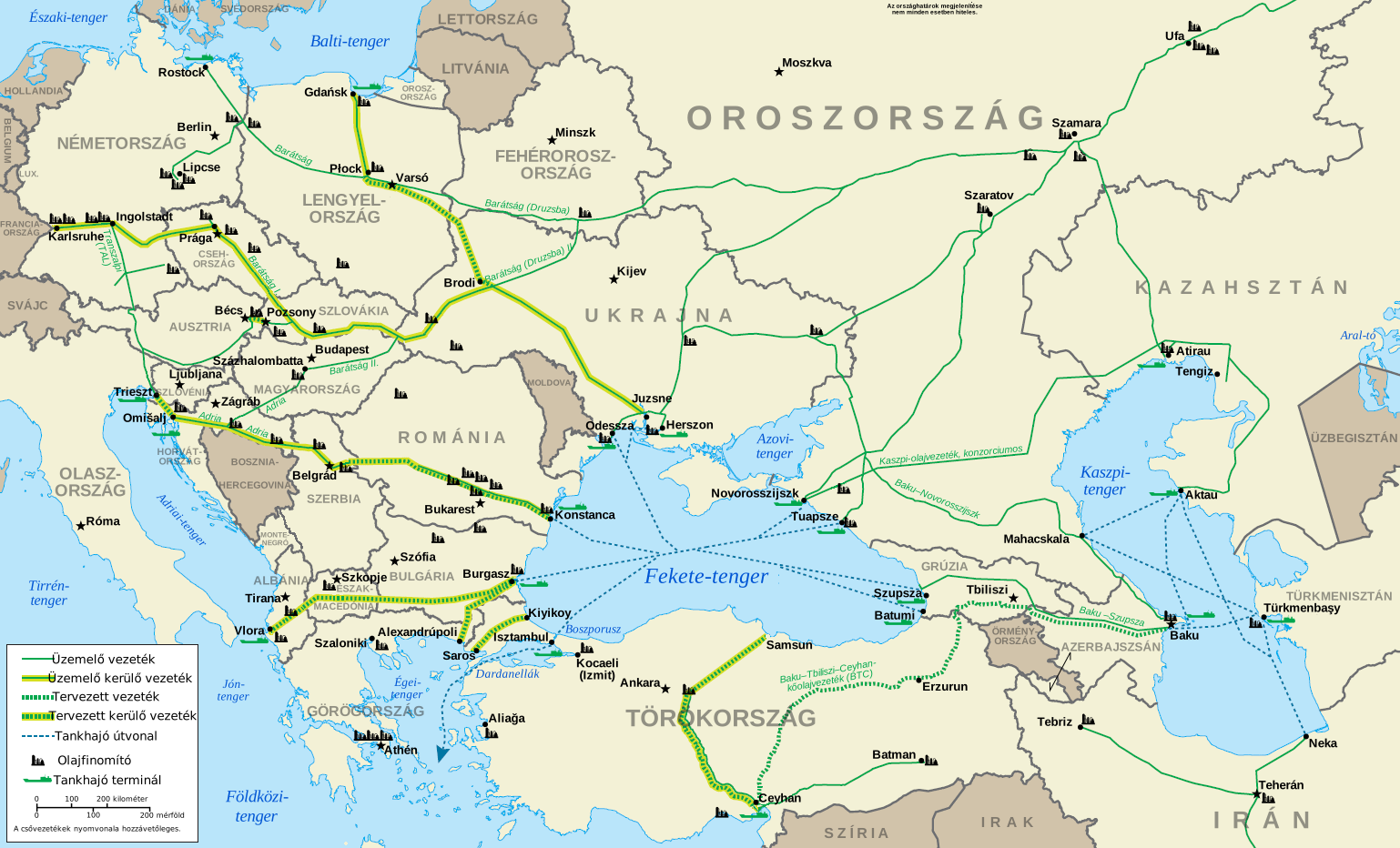
Zelensky’s latest threat is that he will not reopen the Druzhba oil pipeline toward Hungary. In reality, deliveries could continue without any problem if there were the political will on the Ukrainian side.
However, they still see Viktor Orbán as an obstacle, since he has made it clear: we are not willing to finance the war in Ukraine, nor will we comply with Brussels’ demands.
That is precisely why they would like to see a change of government in Hungary, so that the pro-Ukraine Tisza Party could come to power and join the escalation of the war without hesitation.
Blackmail or not, we will not change our pro-peace position.
Let as many of us as possible fill out the national petition and make it clear that we will not send our money to Ukraine!
To be honest, my palm is itching more and more to pick up a pen and, on April 12, scratch that certain X in the right place, because every single day brings some outrageous and infuriating act of blackmail from the Ukrainian side. Today’s news is that even though the Druzhba oil pipeline is technically fully operational, the Ukrainians are unwilling to restart oil deliveries to Hungary. All of this is meant to pressure us into changing Hungary’s position regarding Ukraine or the war.
As a side note, they are so blinded that they are hurting themselves as well, because we refine the diesel from the oil they send us, and we supply it not only for our own use but also to them. So that, too, would stop arriving. But it seems that, for the Ukrainians, nothing matters anymore. They are tightly aligned with Brussels and with Tisza, and in every possible way — even to their own detriment — they are working to change Hungary’s pro-peace stance.
We will not allow this — neither on April 12 nor before. Fill out the national petition in as great numbers as possible and make your voice heard on the most important issues.
1️⃣ Külső ellenség konstrukciója
📌 Technika: collective blame + us vs. them framing
In April, at the election, two fundamentally different paths will stand before us.
👉 One is the Tisza-style path, where Kyiv and Brussels would tell us how to live and what to spend our money on. This would mean Hungary being dragged into the war, our money ending up in Ukraine, and utility prices soaring. At the same time, multinational corporations would once again be free to profit at our expense.
👉 The other path is that we do not allow others to decide over our heads. Viktor Orbán is a leader who is able to consistently say no to Brussels’ demands, which would mean keeping low energy prices, preserving the country’s sovereignty, and most importantly, maintaining peace.
That is why it truly matters where we put the X on April 12. Only Fidesz is the safe choice! 🟠
My dear Szombra — or rather, two things. First, we have already talked about the Ukrainians in the election campaign. What can we do? Well, first of all, we should tell everyone that the stake of this election is whether Ukrainians and Brussels bureaucrats — von der Leyen and Weber — will decide how we should live, whether we should enter the war, send money to Ukraine and the war effort, see our utility costs rise, and watch Hungarian money flow to multinationals and foreign banks.
Or whether we Hungarians can continue to decide our own fate. Because these are the two choices that will stand before us in April.
And listen — today is Shrove Tuesday, tomorrow Lent begins. Do you usually fast? Will you this year as well?
Yes, and it really caught me off guard that today is Shrove Tuesday, because I still have so many plans. This year, for example, I haven’t eaten certain things yet, even though I really enjoy them. And it’s not quick to prepare them, so I don’t know how I’ll fit that in today. In the campaign, you start counting time in a different universe. So now that I’ve realized it’s Shrove Tuesday, I’ll try to make up for something today, have a proper meal with meat, and then the usual fast begins.
1️⃣ False dilemma: “two fundamentally different paths”
📌 Technique: false dichotomy + binary framing
👉 The text claims that only two options exist:
“Tisza path” → war, Brussels, Kyiv, rising utility costs
“Orbán path” → peace, cheap energy, sovereignty
❗ Political reality, however, is rarely this black and white. The voter feels as if they are making an existential decision rather than choosing between policy alternatives.
🎯 Effect: pushes undecided voters toward an emotional, rather than rational, decision.
2️⃣ Construction of an external enemy
📌 Technique: external threat framing + us vs. them
Specific names appear:
Ursula von der Leyen Manfred Weber “Kyiv,” “the Ukrainians,” “Brussels bureaucrats”
👉 Several distinct actors are merged into a single coordinated bloc that supposedly “wants to tell us how to live.”
🎯 Effect:
Activates the sovereignty reflex Turns the election from a policy debate into a matter of national defense
3️⃣ Fear stacking
A sequence of negative consequences is listed:
we get dragged into war our money goes to Ukraine utility costs skyrocket multinationals profit from us
📌 Technique: cumulative threat escalation
👉 Multiple different fears are bundled together as the automatic consequence of one political choice.
🎯 Effect: Fear of loss overrides rational evaluation.
4️⃣ Savior-leader framing
The positive pole is tied to one person:
Orbán Viktor
📌 Technique: heroic obstruction narrative
👉 He is portrayed as the one who is “capable of saying no.” Politics shifts from institutional debate to a question of leadership character.
🎯 Effect: Voting becomes a loyalty decision.
5️⃣ Subtle religious framing
Reference to Shrove Tuesday and Lent.
📌 Technique: identity anchoring + cultural signaling
👉 The campaign message is placed within a cultural-Christian context. This creates emotional closeness with religious communities.
🎯 Effect: The political decision acquires a moral dimension.
📌 Summary
Main tools used in the text:
False binary electoral framing
Construction of an external threat
Fear stacking
Savior-leader narrative
Cultural-religious identification
This is classic siege-state communication: the world is dangerous, external forces are threatening us, and only a strong leader can protect the country.
In April, at the election, two fundamentally different paths will stand before us.
👉 One is the Tisza-style path, where Kyiv and Brussels would tell us how to live and what to spend our money on. This would mean Hungary being dragged into the war, our money ending up in Ukraine, and utility prices soaring. At the same time, multinational corporations would once again be free to profit at our expense.
👉 The other path is that we do not allow others to decide over our heads. Viktor Orbán is a leader who is able to consistently say no to Brussels’ demands, which would mean keeping low energy prices, preserving the country’s sovereignty, and most importantly, maintaining peace.
That is why it truly matters where we put the X on April 12. Only Fidesz is the safe choice! 🟠
My dear Szombra — or rather, two things. First, we have already talked about the Ukrainians in the election campaign. What can we do? Well, first of all, we should tell everyone that the stake of this election is whether Ukrainians and Brussels bureaucrats — von der Leyen and Weber — will decide how we should live, whether we should enter the war, send money to Ukraine and the war effort, see our utility costs rise, and watch Hungarian money flow to multinationals and foreign banks.
Or whether we Hungarians can continue to decide our own fate. Because these are the two choices that will stand before us in April.
And listen — today is Shrove Tuesday, tomorrow Lent begins. Do you usually fast? Will you this year as well?
Yes, and it really caught me off guard that today is Shrove Tuesday, because I still have so many plans. This year, for example, I haven’t eaten certain things yet, even though I really enjoy them. And it’s not quick to prepare them, so I don’t know how I’ll fit that in today. In the campaign, you start counting time in a different universe. So now that I’ve realized it’s Shrove Tuesday, I’ll try to make up for something today, have a proper meal with meat, and then the usual fast begins.
1️⃣ False dilemma: “two fundamentally different paths”
📌 Technique: false dichotomy + binary framing
👉 The text claims that only two options exist:
“Tisza path” → war, Brussels, Kyiv, rising utility costs
“Orbán path” → peace, cheap energy, sovereignty
❗ Political reality, however, is rarely this black and white. The voter feels as if they are making an existential decision rather than choosing between policy alternatives.
🎯 Effect: pushes undecided voters toward an emotional, rather than rational, decision.
2️⃣ Construction of an external enemy
📌 Technique: external threat framing + us vs. them
Specific names appear:
Ursula von der Leyen Manfred Weber “Kyiv,” “the Ukrainians,” “Brussels bureaucrats”
👉 Several distinct actors are merged into a single coordinated bloc that supposedly “wants to tell us how to live.”
🎯 Effect:
Activates the sovereignty reflex Turns the election from a policy debate into a matter of national defense
3️⃣ Fear stacking
A sequence of negative consequences is listed:
we get dragged into war our money goes to Ukraine utility costs skyrocket multinationals profit from us
📌 Technique: cumulative threat escalation
👉 Multiple different fears are bundled together as the automatic consequence of one political choice.
🎯 Effect: Fear of loss overrides rational evaluation.
4️⃣ Savior-leader framing
The positive pole is tied to one person:
Orbán Viktor
📌 Technique: heroic obstruction narrative
👉 He is portrayed as the one who is “capable of saying no.” Politics shifts from institutional debate to a question of leadership character.
🎯 Effect: Voting becomes a loyalty decision.
5️⃣ Subtle religious framing
Reference to Shrove Tuesday and Lent.
📌 Technique: identity anchoring + cultural signaling
👉 The campaign message is placed within a cultural-Christian context. This creates emotional closeness with religious communities.
🎯 Effect: The political decision acquires a moral dimension.
📌 Summary
Main tools used in the text:
False binary electoral framing
Construction of an external threat
Fear stacking
Savior-leader narrative
Cultural-religious identification
This is classic siege-state communication: the world is dangerous, external forces are threatening us, and only a strong leader can protect the country.
👉 We have reached another chapter of Brussels’ war-driven madness. Germany has already sent all of its missiles to Ukraine, and now their defense minister wants us to send weapons as well.
Meanwhile, in Berlin they have even amended the constitution to make unlimited funding available for defense spending, because according to them this is how “responsible nations” act.
🟠 As long as there is a national government in Hungary, we will send neither weapons, nor money, nor our young people to Ukraine. No matter how much pressure they try to put on us from Brussels, we will remain on the path of peace, just as we have done so far.
That is why Fidesz is the safe choice!
Hello, Szandra! Have you heard that the Germans have already sent all their missiles, and now their defense minister is asking us to hand over ours to the Ukrainians as well? What’s happening is sheer madness. We certainly do not want to fuel this war with weapons or money. And if the ultimate consequence were that we would eventually have to send our sons into this war, that would be absolutely unacceptable — so no thank you, we’ve had enough of this madness.
👉 What is happening? The political debate is framed not as a policy issue (defense financing, NATO obligations, EU decisions), but as a form of mental disorder (“madness”).
🎯 Effect:
The opponent appears irrational and dangerous
The debate shifts to a moral plane
Meaningful professional dialogue is shut down
2️⃣ “Germany has already sent all its missiles” – dramatizing exaggeration
📌 Technique: sweeping generalization + fear amplification
👉 What is happening? An absolute claim (“all its missiles”) suggests that a NATO member state has practically disarmed itself.
🎯 Effect:
Creates an immediate sense of danger in the audience
Arms deliveries appear as irrational self-sabotage
Reinforces the narrative of a “reckless West”
3️⃣ “Constitutional amendment for unlimited financing” – responsible nation vs. madness
After the drug party, Péter Magyar has now gotten involved in another scandal in Munich. The staff of a beer hall reportedly called the police on them because neither Péter Magyar nor his group could behave properly. I’m sure this is also somehow Fidesz’s fault.
Péter Magyar has gotten into trouble again. A chaotic character…
1️⃣ “Drug party” – unproven moral accusation
📌 Technique: character assassination + insinuation
A serious allegation is presented as a fact.
There is no source, no date, no report, no evidence.
The phrase “drug party” is a strong emotional trigger: it immediately provokes moral rejection.
🎯 Effect: The political debate turns into a moral issue. A negative image remains in the listener’s mind even if there is no evidence.
2️⃣ “The police were called on them” – apparent concretization
📌 Technique: fabricated specificity (illusion of concreteness)
“In Munich” “Employees of a beer hall” “They called the police”
These sound like details, but: ❌ no names ❌ no exact location ❌ no official source
🎯 Effect: Seemingly concrete details create a sense of credibility even when they cannot be verified.
3️⃣ “Sure, this is Fidesz’s fault too” – mocking framing
📌 Technique: ridicule framing
It preemptively makes any possible denial look ridiculous.
It sarcastically twists the other side’s potential response.
🎯 Effect: The audience emotionally aligns with the presented version before any evidence appears.
4️⃣ “A chaotic figure” – labeling
📌 Technique: labeling
The entire narrative is condensed into a single negative identity.
It does not criticize a specific action but judges the person’s character.
🎯 Effect: A stable, repeatable negative label forms in the voter’s mind.
Overall pattern
The structure is:
Accusation → apparent specificity → mockery → personal labeling.
If no such event actually occurred, this is clearly defamatory-style political communication. If police action did occur, there should be some publicly traceable record of it.