balazska

Today everyone knows: Zelensky is deliberately refusing to reopen the Druzhba pipeline for political reasons! This is how he wants to topple the national government.

This is the fifth round of poster campaigning tonight.
How long will you be out on the streets, Miki?
Until about eleven o’clock. I’m leaving earlier, because Foreign Minister Péter Szijjártó will be on at dawn in the “Hour of Truth,” and as we can see, the international situation is escalating. There is war in the Middle East, and here at home it has become completely clear that Zelensky is intentionally not reopening the Druzhba oil pipeline — and in this he is supported by Péter Magyar and Brussels as well.

This is how they want to bring down the national government.
Our task is to make sure that they do not succeed.

1️⃣ Conspiracy Narrative (“intentionally not reopening it”)

Volodymyr Zelenskyy
Magyar Péter

📌 Technique:
It claims that Zelenskyy is deliberately keeping the pipeline closed for political reasons, in coordination with Magyar Péter and “Brussels.”

🎯 Goal:
To portray the domestic political opponent as an instrument of foreign powers.
Not a policy debate → but a “collaboration with foreign actors” operation.

💥 Effect:
The audience no longer asks, “What is the actual technical or legal situation?”
Instead, they feel that “external interference is taking place.”


2️⃣ Use of Infrastructure as a Symbol

Druzhba pipeline

📌 Technique:
It simplifies a complex international energy system into a push-button narrative: “open it / don’t open it.”

🎯 Goal:
To frame oil supply as a matter of political intention rather than a question of:
– transit law
– contractual obligations
– war-related risks
– technical condition

💥 Effect:
The audience does not think about the Brent–Urals differential, refinery configuration, or transit agreements (which you regularly analyze),
but instead receives a simple scapegoat.


3️⃣ Internal–External Enemy Bloc

📌 Technique:
“Zelenskyy + Magyar Péter + Brussels” = a coordinated block.

🎯 Goal:
To transform political competition into a struggle for national sovereignty.

💥 Effect:
The debate shifts from policy substance to identity conflict.


4️⃣ Dramatic Background Escalation

📌 “War in the Middle East”
📌 “The international situation is escalating”

🎯 Goal:
To maintain a constant atmosphere of crisis.

💥 Effect:
The voter seeks security, not information.


5️⃣ Vague Visual Proof

As you pointed out:

“They keep showing a picture that nobody knows how to interpret.”

📌 Technique:
– A visual element that appears to be concrete evidence
– But without professional explanation
– Without context
– Without independent verification

🎯 Goal:
To create the feeling of “Here is the proof” without making a verifiable claim.

💥 Effect:
The image functions as emotional evidence rather than rational data.


🎯 The Core of the Communication in One Sentence

It is not trying to prove the pipeline’s actual technical condition.
It is trying to convince the audience that a coordinated internal–external coalition is deliberately harming Hungary — and that only the current government can prevent it.

balazska

While a global oil crisis is looming, Zelensky is keeping the Druzhba pipeline closed, with the knowledge and consent of Tisza.

I’m at a petrol station in Budapest right now — diesel costs 577 forints per liter. I’ve just finished refueling and paid. The point is, it won’t stay at 577 for long, because due to the Iranian crisis and the war, oil prices on the global market have already surged significantly today. And this will obviously ripple through to Europe and Hungary as well.

In a situation like this, it is even more frustrating, infuriating, and hostile that the Ukrainian blackmail continues. They are not reopening the Druzhba oil pipeline. Even though satellite images now prove — I’ll post them in the comments — that there is no technical or mechanical obstacle. The only reason oil is not flowing through the Druzhba pipeline is political. Zelensky is simply not allowing crude oil deliveries.

And in all of this, the Tisza Party is his partner at home, since Tisza and Péter Magyar have made a pact with Brussels, Berlin, and Kyiv. Their objective is now completely clear: they want chaos in Hungary. They want fuel prices to skyrocket, and — according to their intentions — to sweep away the national government that opposes the war and opposes Ukraine’s accession to the European Union.

1️⃣ Crisis Framing

📌 Technique:
He starts from a concrete, everyday situation (“diesel is 577 forints”), then immediately elevates it into a global crisis: the Iranian conflict, war, and rising world oil prices.

🎯 Goal:
To directly link the viewer’s personal wallet to geopolitical events.

💥 Effect:
The audience does not analyze the complexity of fuel pricing (Brent crude, refining margins, taxation), but instead feels an immediate threat: “this is going to get more expensive.”


2️⃣ External Enemy + Internal Traitor Narrative

📌 Technique:

  • External actor: Volodimir Zelenszkij
  • Internal actor: Tisza Párt
  • Personalization: Magyar Péter
  • Abstract external powers: “Brussels”, “Berlin”, “Kyiv”

🎯 Goal:
To transform an economic issue into a national security conflict.
Fuel prices → framed as the result of a political conspiracy.

💥 Effect:
The voter no longer asks:
“What is the oil market mechanism?”
But instead:
“Who is trying to harm us?”


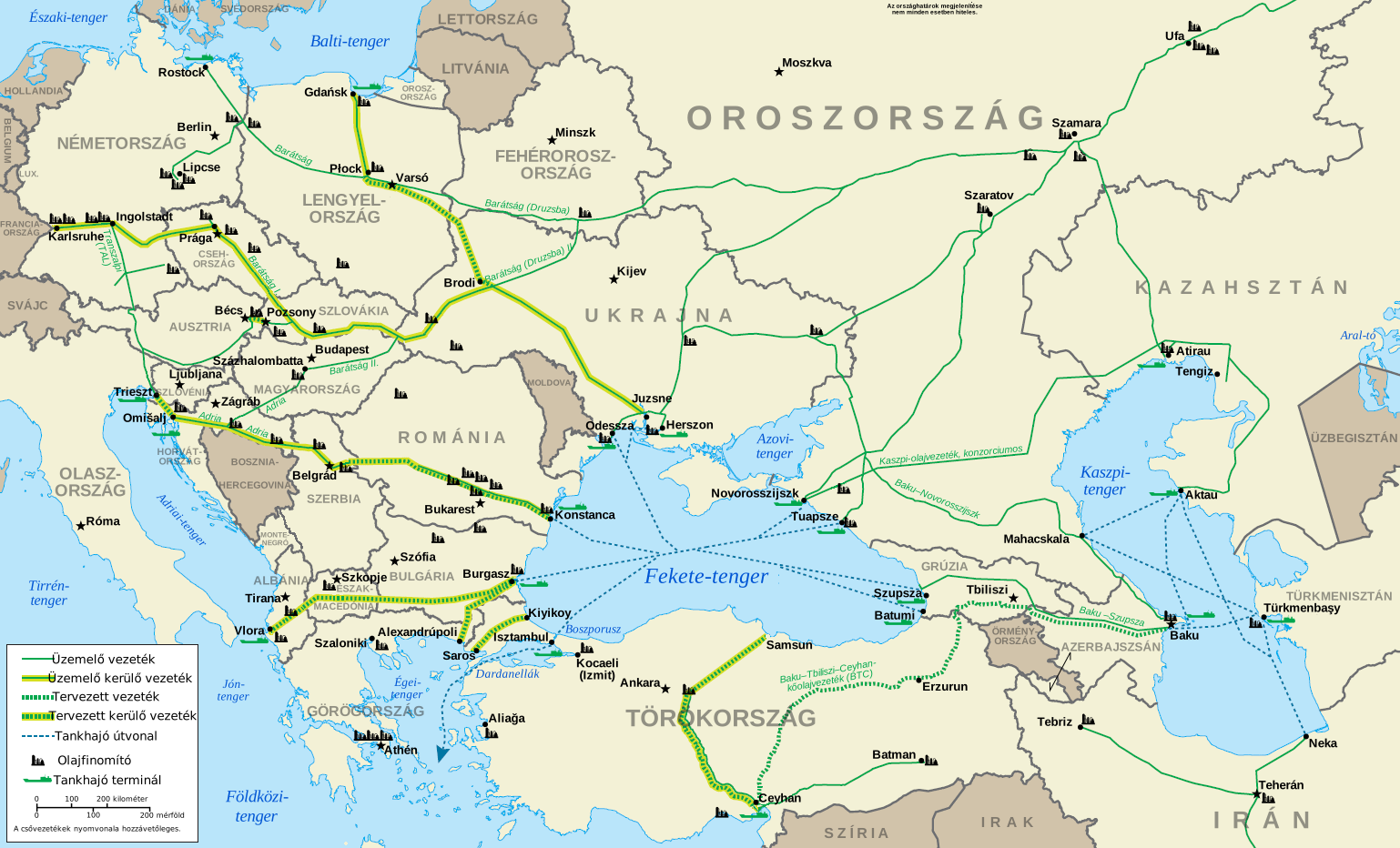
🛢️ The Druzhba Pipeline as a Symbol

https://images.openai.com/static-rsc-3/iQNQeORZrXMdDjiUi-wMw55cJzOQhlO420wwx1L48uOeGF0fEoQy2ugqn0LGf5GIUlt0CBngXElL17kcf_Q2-lI96Vc5X4FHxbIMy8N0K_g?purpose=fullsize&v=1
https://upload.wikimedia.org/wikipedia/commons/b/b1/Oil_pipelines_in_Europe_hu.svg
https://upload.wikimedia.org/wikipedia/commons/a/ad/Oil_pipelines_in_Europe.png

4

The Barátság kőolajvezeték (Druzhba oil pipeline) is presented not merely as technical infrastructure, but as:

  • a tool of sovereignty
  • a symbol of economic stability
  • an emblem of “blocked” national interest

📌 Technique:
Reference to satellite images (“they prove it”) — without providing detailed technical analysis.

🎯 Goal:
To elevate the debate from a technical issue to one of political intent.

💥 Effect:
For the audience, the possibility of a “technical malfunction” disappears.
Only political ill will remains as an explanation.


3️⃣ Intent Attribution

📌 Technique:
“Their goal is to create chaos.”
“They want fuel prices to skyrocket.”

🎯 Goal:
To attribute deliberate destructive intent to the opponent.

💥 Effect:
Moral outrage.
The issue becomes not a political debate, but a moral judgment.


4️⃣ Existential Threat Framing

📌 Technique:

  • Iranian crisis
  • war
  • oil price explosion
  • chaos in Hungary

🎯 Goal:
To frame the election as a choice between stability and collapse.

💥 Effect:
Voters seek security rather than weighing alternatives.


5️⃣ Cause-and-Effect Simplification

Reality includes:

  • global Brent price
  • refining capacity
  • transportation costs
  • tax structure
  • exchange rate of the forint

Narrative:

👉 Zelensky doesn’t reopen →
👉 no oil →
👉 expensive fuel →
👉 chaos

🎯 Goal:
To reduce a complex market process to the actions of a single political actor.


🔥 Summary – What Toolkit Appears?

  • Crisis dramaturgy
  • External enemy construction
  • Internal traitor narrative
  • Intent attribution
  • Evidence-free conspiracy framing
  • Turning an economic issue into a moral war narrative

balazska

The violent Tisza sect is keeping Fidesz voters in fear, both online and in real life! But on April 12, the moment of truth will arrive! Fidesz is the safe choice! 🧡👍

You’ve been collecting signatures for more than a week now. What are your experiences so far?

First of all, it’s simply not true that there are no young people on the right, on the patriotic side. A great many young people, young adults, and even middle-aged citizens are approaching us.

The other thing — which is thought-provoking, discouraging, and also a warning sign — is that many people say they have to hide their opinions. They are kept in fear by their colleagues, kept in fear by their bosses; they are afraid of the aggressive pressure of the opposition “sect.”

But they also say that on April 12, in the privacy and solitude of the voting booth, they know what the safe choice is.

🧠 Balázska’s Communication – Propaganda Analysis

Structure: Technique – Goal – Effect


1️⃣ Demonization of the Enemy (“violent Tisza sect”, “they are kept in terror”)

📌 Technique:
The opponent is portrayed not as a political rival, but as a threatening, extremist group.

🎯 Goal:
To generate moral panic and frame political competition as a security issue.

💥 Effect:
Followers stop thinking in terms of policy and shift into a defensive reflex.
Debate is replaced by identity-based conflict.


2️⃣ Generalization Without Evidence

📌 Technique:
“Very, very many people say…” — without concrete data, case numbers, or documented examples.

🎯 Goal:
To create a sense of reality around the narrative without making verifiable claims.

💥 Effect:
Repetition creates emotional credibility for an unproven statement.


3️⃣ Fear Appeal Through Workplace Retaliation

📌 Technique:
“They are kept in terror by their colleagues and bosses.”

🎯 Goal:
To make the audience project the threat into their own personal lives.

💥 Effect:
Political choice becomes an act of existential self-defense.


4️⃣ The “Silent Majority” Myth (“in the privacy of the voting booth”)

📌 Technique:
The classic “silent majority” narrative: many are afraid, but secretly with us.

🎯 Goal:
Mobilization and hope maintenance, even when public visibility suggests otherwise.

💥 Effect:
Followers feel they are not alone — even if they appear to be in the minority in their environment.


5️⃣ Apocalyptic Timing (“the moment of truth will come”)

📌 Technique:
Framing the election as a historic, destiny-defining event.

🎯 Goal:
Maximum emotional mobilization.

💥 Effect:
Rational evaluation fades; the decision becomes a moral obligation.


🔎 The Key Question

If there is truly “terror”:

  • Where are the concrete cases?
  • Where are the official complaints?
  • Where are the documented labor law disputes?
  • Where are the police procedures?

“Terror” is a legal category.
Without evidence, it is a political metaphor.


🎯 Summary

This text is a classic example of:

  • enemy image construction
  • fear-based messaging
  • evidence-free generalization
  • silent majority narrative
  • emotional mobilization

It is not fact-based argumentation, but identity-based mobilization.

balazska

There is peace, there is no war, no migrant violence, no Islamist terrorism, no Antifa terrorism. Fidesz is the safe choice 🇭🇺✌️

A run on Sunday early afternoon, birds are chirping, there is peace, no war, no migrant violence, no Islamist terrorism, no Antifa terrorism. Fidesz is the safe choice. April 12. 06. 07. still to come.

balazska

Brussels, Kyiv and Tisza would drag Hungary into the war. In their view, that is the right course of action. Népszava even wrote this today. We will not allow it!

According to Népszava, you are a warmonger. I read it — they are attacking you quite harshly. According to Népszava, there is nothing wrong with Manfred Weber sending soldiers to Ukraine. They also see no problem with Hungarian soldiers going as well.

Népszava argues that Hungary should contribute to the 90-billion war loan, so that the country could finally stand on the “right side of history.” They also write that Hungary should immediately break away from cheap Russian energy, because otherwise we are financing Putin’s war.

They further claim that forced conscription in Transcarpathia is not a problem — even if it affects ethnic Hungarians — since Ukraine is at war and Ukrainian citizens must go and fight.

So that is Népszava’s position. That is the opinion of the author — and, according to this narrative, the opinion of Brussels, Kyiv and the Tisza Party as well.

Our position, however, is that Hungary must be kept out of the war.

🧠 Rhetorical–Propaganda Analysis of the Text

Structure: Technique – Goal – Effect


1️⃣ Consolidated Enemy Image (“Brussels + Kyiv + Tisza + Népszava”)

📌 Technique:
Merging separate actors into a single unified will.

🎯 Goal:
To frame a domestic political debate as foreign interference.

💥 Effect:
The voter no longer sees a media or policy debate, but a narrative of “external forces vs. Hungary.”


2️⃣ Dramatization of a Secondary Source

📌 Technique:
“Even Népszava wrote this today!” – presented as if it were conclusive proof.

🎯 Goal:
Legitimation: “It’s not us saying it — they are.”

💥 Effect:
The audience perceives “dragging Hungary into war” as an openly declared program.


3️⃣ Maximizing Moral Outrage

📌 Technique:

  • “Hungarian soldiers would be sent”
  • “90-billion war loan”
  • “Forced conscription in Transcarpathia”
  • “Including ethnic Hungarians”

🎯 Goal:
Shift the frame from geopolitical debate → to an identity-based issue.

💥 Effect:
Emotional reaction (fear, anger, protective instinct).


4️⃣ Moral Dichotomy

📌 Technique:
“They would take the country to war”
“We keep it out”

🎯 Goal:
Create a black-and-white electoral frame.

💥 Effect:
The political debate is reduced to: peace vs. war.


🌍 European Union
🇺🇦 Ukraine
🇭🇺 Hungary
🧑‍💼 Manfred Weber
🧑‍💼 Vladimir Putin

(The inclusion of these actors serves to increase the geopolitical weight of the narrative.)


🎯 Core Logic of the Communication

This is not primarily about what a specific article actually wrote.
It is a mobilizing political frame that:

  • designates an external threat
  • links it to internal opponents
  • simplifies the issue into a moral choice

balazska

One of the pro-war authors of Népszava has taken aim at me 😳

❗️They are upset that in my Facebook videos I draw the attention of Hungarian voters — including those in North Pest — to the European war threat and Brussels’ war hysteria.

Let’s see the arguments they use to attack me 😅

📍 According to Népszava, Manfred Weber (editor’s note: Péter Magyar’s superior in the European People’s Party) does not want to send civilians to Ukraine, only soldiers.

📍 According to Népszava, that is perfectly fine — and it would also be fine if Hungarian soldiers were part of an EU army.

📍 According to Népszava, there is no point in “fearmongering” at home, because no country can be dragged into a war against its will — meaning Hungary is not in danger either.

This is nonsense to begin with! Moreover, Brussels is not drifting unwillingly into a major war against Russia — it is going into it deliberately, and would take all member states along.

(Hungary would only be taken along for now. And that will remain the case only as long as there is a national government in Budapest!)

📍 According to Népszava, there is nothing wrong with hundreds of billions of forints of Hungarian taxpayers’ money going to Ukraine, because at least we would finally be “on the right side.”

📍 According to Népszava, we must naturally give up cheap Russian energy — otherwise we would continue financing Putin’s war machine.

📍 And according to Népszava, those ethnic Hungarians (and others) in Transcarpathia who try to avoid forced conscription are breaking the law — meaning it is right that Ukrainian authorities take them to the front.

☝️ This is Népszava — the voice of Brussels leaders, the Tisza Párt, liberal-left portals, and the hard core of Tisza supporters!

— They would drag Hungary into war;
— They would send Hungarians’ money to Ukraine;
— They would admit Ukraine into the EU;
— They would nod along to 1,000-forint fuel prices and the abolition of utility price caps;
— They would send weapons and people into a major war against Russia.

❗️I warn every peace-supporting Hungarian against them❗️

🇭🇺🇭🇺❤️

balazska

The Tisza supporters are outraged because the government has raised the terrorism threat level. In times of danger, the country must not be entrusted to irresponsible people!

Right on schedule, Facebook comments have started pouring in from the hard core of Tisza supporters, mocking the fact that the Defense Council has raised the terrorism threat level. “Orbán is just fearmongering,” they say. “This shows they’re in trouble. There is no danger at all. Iran is far away from Hungary.”

Well yes — this is the same hate-filled bubble that keeps insisting there is no war. There is a war in our neighborhood, and the Middle East is literally in flames. I would also like to remind even the members of the hard core that Péter Magyar’s bosses in Brussels have, over the past more than ten years, allowed masses of illegal migrants into the European Union — thereby importing Middle Eastern tensions into Europe.

So in a situation like this, it is entirely possible that extremists may want to take revenge in Europe for attacks against Iran or the Arab world.

For the responsible Hungarian government — unlike the irresponsible Facebook opposition — the safety of the Hungarian people comes first and foremost. That is why the terrorism threat level has been raised.

Go ahead, you can continue posting your nonsense comments.

1️⃣ Enemy Image Construction (“Tisza hard core,” “hate-filled bubble”)

📌 Technique:
Portrays opposition commenters as a homogeneous, extremist group.

🎯 Goal:
To delegitimize criticism — it’s not an argument, just a “bubble.”

💥 Effect:
Followers don’t examine the actual question (Was the threat-level increase justified?) but immediately pick a side.


2️⃣ Fear Appeal by Referencing Global Chaos

📌 Technique:
“War next door,” “the Middle East is in flames,” “extremists seeking revenge.”

🎯 Goal:
To evoke a sense of worldwide instability instead of focusing on the concrete Hungarian situation.

💥 Effect:
The proportionality of the measure is no longer evaluated — in “times of danger,” everything seems justified.


3️⃣ Shifting Blame (“Brussels let them in”)

📌 Technique:
Links the migration debate directly to the terrorism threat level.

🎯 Goal:
To frame the government’s decision as preventive while portraying the opposition as irresponsible.

💥 Effect:
Criticism of the measure becomes equated with pro-migration naïveté.


4️⃣ False Dilemma

📌 Technique:
“Responsible government” vs. “irresponsible Facebook opposition.”

🎯 Goal:
To reduce the debate to two extremes.

💥 Effect:
Middle-ground positions (e.g., “ensure security, but transparently”) disappear.


5️⃣ Preemptive Discrediting (“Go ahead and keep commenting your nonsense”)

📌 Technique:
Intellectual belittling of debate partners.

🎯 Goal:
To shut down discussion before substantive questions can arise.

💥 Effect:
Followers do not question — they applaud.


🎯 The Narrative’s Deep Structure

Basic formula:

Global chaos → Brussels’ fault → Extremist threat → Responsible government protects the country → Whoever doubts is naïve or dangerous.

This is a classic security-mobilization frame:

fear → external enemy → internal traitor → strong leadership.


🔎 What Is Missing from the Communication?

  • Concrete, verifiable information about the reasons for raising the threat level
  • Details of the risk assessment
  • Time limitations
  • Justification of proportionality

The emphasis is not on professional transparency, but on emotional mobilization.

havent got words and Dominik Fodor

We will make Rákospalota great! Long live the youth!

Another poster has found its owner. Dominik Fodor is here. Hello, thank you very much for coming. My pleasure. What will happen to the poster? Well, I’ll put it up in my room, because the future of the country is important to me. Young people, the future is yours. A safe choice. Thanks again for coming. You’re welcome. Let’s go! It’s yours!