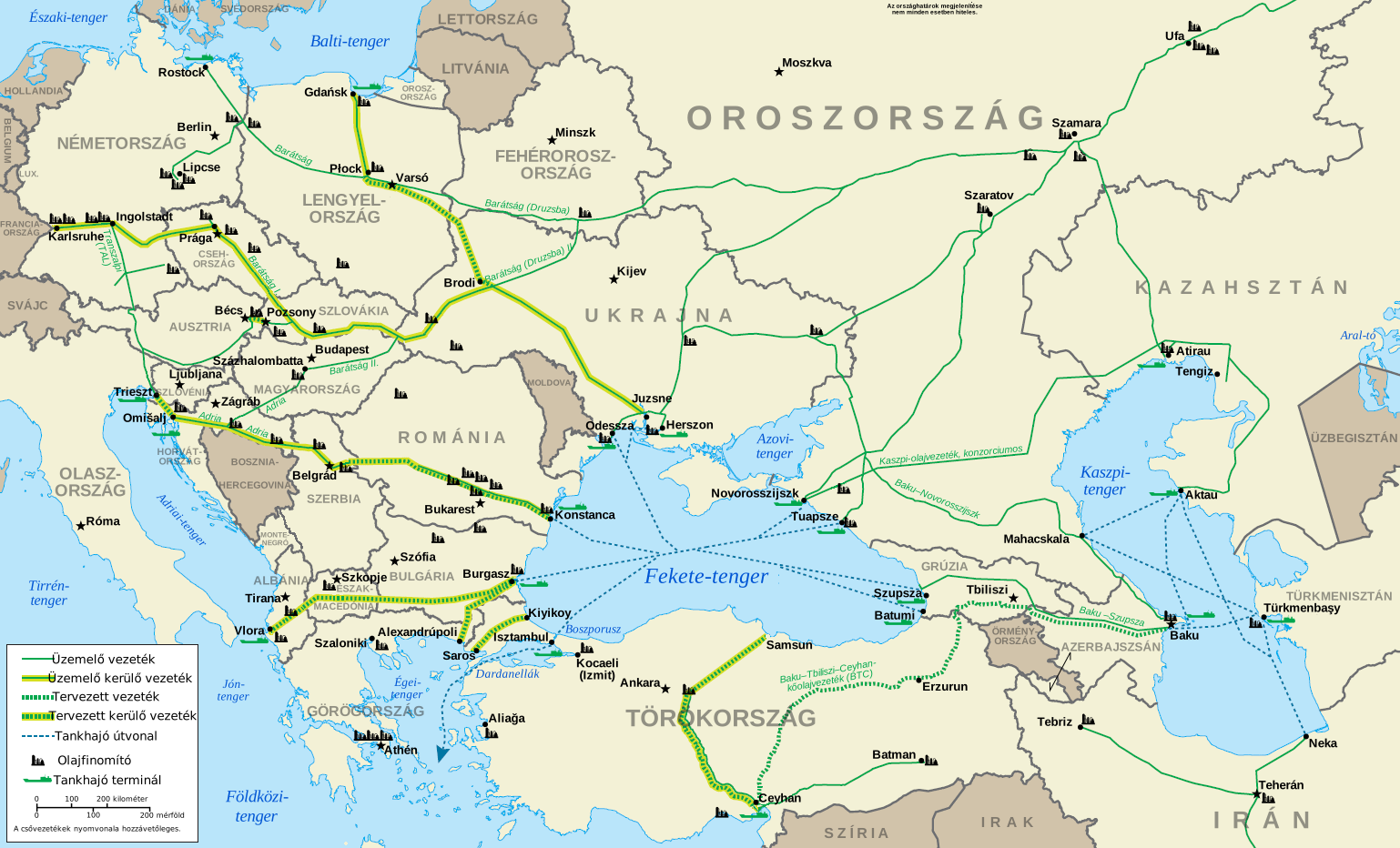
The Ukrainians want the Orbán government to fall; that is why no oil is coming through the Druzhba pipeline. The Tisza party has also said it clearly: the worse it is for the Hungarian people, the better it is for them.
It is completely obvious. The Ukrainians want a fuel crisis and brutal petrol price increases in Hungary before the elections — hoping that this will bring down the Orbán government. Brussels approves of all this, and Tisza supporters have already said that the worse it is for the Hungarian people, the better it is for them. We must not allow ourselves to be blackmailed.
1️⃣ Construction of an External Enemy
“The Ukrainians want the Orbán government to fall.”
📌 Technique: collective blame + attribution of intent at the national level
👉 An entire country is portrayed as a unified, conscious political actor interfering in Hungarian domestic politics. 👉 The conflict is not framed as an energy or war-related consequence, but as a deliberate political attack.
🎯 Effect:
Activates the “us vs. them” reflex
Turns the election from a policy issue into a matter of national defense
2️⃣ Attribution of Intent Without Evidence
“They want a fuel crisis… they want brutal petrol price increases.”
📌 Technique: intent projection
👉 It’s not presented as “supplies have stopped,” but as “this is what they want.” 👉 Intent is asserted as fact, without evidence.
🎯 Effect:
Triggers moral outrage
Shifts the issue from a technical question (war damage, logistics, infrastructure) to one of malicious intent
3️⃣ Fear Stacking – Layering Fears
Key elements:
fuel crisis
brutal price increases
destabilization before the elections
📌 Technique: economic fear-mongering + political conspiracy framing
🎯 Effect:
Targets everyday security (fuel stations, prices)
Creates a sense of existential threat
4️⃣ Scapegoating + Political Linking
“Brussels approves.” “The Tisza party already said it.”
📌 Technique: enemy coalition building
👉 External enemy (Ukraine) + internal opponent (the opposition) + Brussels → framed as a single bloc. 👉 This makes any criticism automatically appear as serving “foreign interests.”
🎯 Effect:
Closes off debate
Anyone questioning the narrative is framed as being “on their side”
5️⃣ The Closing Line: “We must not let them blackmail us.”
📌 Technique: heroic resistance framing
👉 The government is positioned as the protector. 👉 The voter is placed in a moral dilemma: resist or surrender.
Who decides what happens in Europe? In an ideal world, it would be the European people and the elected politicians who represent their interests — but with the way Brussels is structured today, that could hardly be further from reality. Let me explain.
What is worth noticing — and what lesson should be drawn — is that Europe does not decide its own fate. Let me start a bit further back. In the early 2010s, the EU economy was roughly the same size as that of the United States (whereas today the U.S. economy is about 40 percent larger than the EU’s).
The Democratic leadership in the U.S. did not take that lightly. It is worth looking at what happened next. The second Obama–Biden administration began in early 2013.
And already in 2013, all hell broke loose:
ISIS and terrorism surged in Syria.
In 2014, Kyiv was turned upside down, and the first phase of the Ukrainian–Russian war broke out: Donetsk, Luhansk, and Crimea separated.
In 2015 came the million-strong migration crisis.
In 2016, the British were pushed out of the EU.
The EU suffered four massive blows in four years under the Democrats — blows it has still not recovered from. It might be worth Brussels noticing this when they criticize Trump.
And speaking of Trump: what else happened in 2016?
Out of nowhere, like a comet, Donald Trump won — and suddenly this entire series of global crises came to a halt. There were four years of calm. Then came 2020, the Democrats returned with Biden, and they continued where Trump had interrupted them: war in Ukraine, war in the Holy Land, war in the Caucasus, a Taliban government in Afghanistan, gender madness, woke ideology, migration, Soros dollars. And the world was on fire again. Then came 2024, Trump returned — and since then he has been signing peace agreements one after another.
So: whether Europe experiences more peaceful or more turbulent eras has not depended on Europe or on its leaders sitting in Democratic pockets, but on politics in Washington. When the Democrats are in power, the world is in flames and Europe races toward its grave; when Trump governs, there is calm and peace.
That is why it is important that, until peace-oriented patriotic forces representing the interests of European people take power in Brussels from the Democrat-linked, corrupt, pro-war elites — our best chance is to support the Republican American administration.
Because in Brussels — just as between 2016 and 2020 — they are playing for time. They are hoping that after Trump, their Democratic allies will return to power, supporting war, migration, and gender ideology. Fortunately, the situation in America does not suggest that this will happen.
At home, the same applies: the left wing, sent here from Democratic circles and directed from Brussels, is once again trying to seize power — as always. They will not succeed.
Viktor Orbán has been leading the patriotic, national uprising in Europe since 2010. Our allies have never been stronger, the wind is in our sails, we are large and strong.
All we have to do is vote for Fidesz on April 12 and continue the rebellion against Brussels together with the people of Europe. The future is ours — forward to victory!
1️⃣ External Control Narrative – “Europe does not decide its own fate”
📌 Technique: sovereignty stripping + shadow power framing
👉 The core claim: Europe is not autonomous; Washington controls events. 👉 Brussels is portrayed as being in the pockets of Democrats.
🎯 Effect:
Undermines the legitimacy of EU institutions
Activates national self-defense instincts
Provides a simple scapegoat for complex geopolitical dynamics
2️⃣ Timeline Manipulation – Implied Causality
📌 Technique: post hoc ergo propter hoc + narrative stitching
Obama–Biden → ISIS, Ukraine, migration, Brexit Trump → “the world stopped burning” Biden → wars return
👉 Temporal coincidence is framed as causal responsibility.
🎯 Effect:
Links complex geopolitical processes to a single political cycle
Assigns moral blame based on party labels
Creates a simplified, emotionally compelling worldview
3️⃣ Apocalyptic Exaggeration – “The world is burning”
I already know what you’ll be doing on March 15 — you’ll be there with me, with us, at the biggest peace march ever. On March 15, we’ll have the opportunity to experience together what it feels like when so many people send a message to Brussels and make it clear that we do not want war.
So get ready, raise the flags high — see you there!
The fortune cookie also sends a message: Fidesz is the safe choice!
However, victory requires not only luck, but also a lot of hard work — and unity among people who long for peace.
👉 Those who want a sovereign Hungary and leadership that puts Hungarian interests first will mark their X next to Fidesz on April 12.
Here you go — happy Chinese New Year! Here’s the first cookie. Happy Chinese New Year to you too! This is the kind you break open, right? Yes. Alright, let’s open it together.
Well, there it is: Fidesz is the safe choice. And we can’t rely on luck alone — in the 54 days ahead, we still have a great deal of work to do, building on what we have already achieved.
I believe the Hungarian people will know what Hungary’s interests are on April 12, so I am expecting a big victory.
1️⃣ Fortune Cookie Motif – Playful Trivialization
📌 Technique: humorous framing + light packaging of a political message
The campaign message appears as a “prediction” inside a fortune cookie. 👉 This places the political claim in a playful, smiling context rather than a confrontational one. 👉 The element of “chance” (luck) seems to symbolically reinforce the message.
🎯 Effect:
Reduces political tension
Makes the message more memorable
Links humor with party choice
2️⃣ “Safe Choice” – Security Framing
📌 Technique: safety framing + activation of risk aversion
“Fidesz is the safe choice.”
👉 The focus is not on policy programs, but on security. 👉 The election is implicitly framed as a choice between risk and safety.
🎯 Effect:
Steers undecided voters toward stability
Reinforces emotional decision-making (sense of security)
3️⃣ Performance + Work – Merit-Based Legitimation
📌 Technique: performance framing
“It’s not only about luck, but also about work and our past achievements.”
👉 After the luck motif, rationalization immediately follows: this is not accidental victory, but earned success.
🎯 Effect:
Makes victory appear morally justified
Mobilizes the core base (“54 more days of work”)
4️⃣ Sovereignty as a Trigger Word
📌 Technique: identity framing + emphasis on national interest
“Sovereign Hungary,” “Hungarian interests.”
👉 The debate is not framed as a concrete policy discussion, but as a matter of identity. 👉 Voting becomes a moral and emotional act.
🎯 Effect:
Implicit “us vs. them” framing
The decision appears not merely partisan, but strategic for the nation
5️⃣ Projecting a Narrative of Victory
📌 Technique: bandwagon effect (joining the winner)
“I expect a great victory.”
👉 Communicating expected victory can function as a self-fulfilling mechanism. 👉 Voters tend to gravitate toward the perceived winning side.
🎯 Effect:
Energizes the base
Pulls undecided voters toward the projected winner
📌 Summary
This communication strategy:
Softens the political message with humor
Frames the election in terms of security
Legitimizes itself through performance
Activates national identity
Projects confidence and inevitability of victory
Strategically, it is not aggressive, but rather light, confident, and security-centered campaign communication that encourages emotional and identity-based decision-making.
From Saturday, we begin collecting signatures! We will not go to war, we will not pay Ukraine, and we will not give up the utility price cuts! Only Fidesz 🇭🇺
Good afternoon, this is Balázs Németh from Fidesz, the Fidesz–KDNP parliamentary candidate. I am contacting you because we are starting to collect nomination signatures on Saturday, and I would like to ask whether you could support me with your signature.
Would it be possible for you to come to the Fidesz office, or would it be more convenient if we visited you at home on Saturday morning? We expect to arrive between 9 and 10 a.m. We will be there—thank you.
So we’re coming for signatures—after all, who wouldn’t support the safe choice? We will not go to war, we will not send the Hungarian people’s money to Ukraine, and we will preserve the utility price cuts.
1️⃣ War Fear Framing
📌 Technique: fear framing + raising the existential stakes
“We will not go to war.”
👉 The election is framed not as a choice between political alternatives, but as a question of war or peace. 👉 The claim that “we would go to war” functions as an implicit threat, without concrete evidence.
🎯 Effect:
Gives the election existential weight
Activates the security reflex
Pushes voters toward an emotional decision
2️⃣ Financial Fear Stacking
📌 Technique: fear stacking (layering multiple fears)
Key phrases:
“We will not pay Ukraine.”
“We will not give up utility price cuts.”
👉 Alongside the war threat, an immediate financial threat is introduced. 👉 Losing utility price cuts symbolizes the loss of everyday economic security.
🎯 Effect:
Pulls a geopolitical debate down to the level of household bills
Intensifies fear of personal financial loss
3️⃣ False Consensus (“Who wouldn’t support…?”)
📌 Technique: bandwagon effect + social pressure
“Who wouldn’t support the safe choice?”
👉 Support is presented as the default, rational position. 👉 Anyone who does not support it is implicitly framed as irresponsible.
🎯 Effect:
Creates social pressure
Pushes undecided voters toward aligning with the perceived majority
❗ Péter Magyar pledged loyalty to his Brussels bosses at the pro-war conference in Munich.
Polish Prime Minister Donald Tusk — with whom the Tisza leader even took a selfie — explicitly said that we are living in a pre-war era.
According to Weber, being pro-Ukraine is a basic requirement, and more and more support must be sent to them.
Tisza agrees with all of this; they would disregard Hungarian interests.
As long as we are in government, we will not give Hungarians’ money to Ukraine, and we will stay out of the war.
🕊 We are on the path of peace, and as far as it depends on us, it will remain that way.
🟠 Fidesz is the safe choice!
Just take a look at whom Péter Magyar pledged loyalty to at the Munich pro-war conference. That alone says enough. Recently, Viktor has been attacked by everyone connected to this circle because of Ukraine. Over the weekend, Viktor Orbán was criticized in Munich for not sending money to Ukraine. Péter Magyar was also summoned there and took selfies with all the pro-war politicians.
We are living in a time of war. They say we must support Ukraine and move toward military cooperation. €90 billion has been allocated to Ukraine. Péter Magyar would not be able to say no to Brussels — they have made that clear once again. There is no difference between the parties that support the war agenda: pro-Europe, pro-Ukraine, pro-federalization.
With Tisza, we would be dragged into the war, our money would be sent to Ukraine, and utility prices would skyrocket.
It would be easier to list what we didn’t talk about! 😅 Culture, opera, Budapest, urban development, the harmful effects of the online world, war, Ukraine, and the future of the EU – thank you to Scruton and the Digital Civic Circles for bringing together this great discussion with Mária Schmidt and Szilveszter Ókovács!
We touched on many areas, but one thing is undeniable: the development of the past 16 years. And it is equally clear that the years ahead will be decisive for both Europe and Hungary.
In an age of dangers, the safe choice is Fidesz! 🧡
Zelensky’s latest threat is that he will not reopen the Druzhba oil pipeline toward Hungary. In reality, deliveries could continue without any problem if there were the political will on the Ukrainian side.
However, they still see Viktor Orbán as an obstacle, since he has made it clear: we are not willing to finance the war in Ukraine, nor will we comply with Brussels’ demands.
That is precisely why they would like to see a change of government in Hungary, so that the pro-Ukraine Tisza Party could come to power and join the escalation of the war without hesitation.
Blackmail or not, we will not change our pro-peace position.
Let as many of us as possible fill out the national petition and make it clear that we will not send our money to Ukraine!
To be honest, my palm is itching more and more to pick up a pen and, on April 12, scratch that certain X in the right place, because every single day brings some outrageous and infuriating act of blackmail from the Ukrainian side. Today’s news is that even though the Druzhba oil pipeline is technically fully operational, the Ukrainians are unwilling to restart oil deliveries to Hungary. All of this is meant to pressure us into changing Hungary’s position regarding Ukraine or the war.
As a side note, they are so blinded that they are hurting themselves as well, because we refine the diesel from the oil they send us, and we supply it not only for our own use but also to them. So that, too, would stop arriving. But it seems that, for the Ukrainians, nothing matters anymore. They are tightly aligned with Brussels and with Tisza, and in every possible way — even to their own detriment — they are working to change Hungary’s pro-peace stance.
We will not allow this — neither on April 12 nor before. Fill out the national petition in as great numbers as possible and make your voice heard on the most important issues.
1️⃣ Külső ellenség konstrukciója
📌 Technika: collective blame + us vs. them framing